Why Footwork Matters More Than Power
You cannot punch what you cannot reach. You cannot defend what you cannot move away from. These two facts make footwork the single most important skill in boxing — more important than punching power, more important than hand speed, more important than chin durability.
Boxing footwork is not just about moving around the ring. It is about controlling distance, creating angles, and positioning yourself to hit without being hit. Every offensive and defensive action in boxing begins with the feet. A punch starts with a push off the rear foot. A slip begins with a weight shift. An exit after a combination requires a step. Without sound footwork, none of these actions work properly.
Watch Vasyl Lomachenko and pay attention to his feet rather than his hands. You will see constant small adjustments — tiny steps that create angles his opponents cannot defend, pivots that take him off the center line before punches arrive, lateral movements that make him appear and disappear like a ghost. That is where the fight is actually won. Willie Pep, the featherweight champion from the 1940s, is said to have won a round without throwing a single punch — purely through footwork that made his opponent chase shadows. Whether that story is literally true or not, it captures the fundamental truth: the fighter who controls position controls the fight.
Manny Pacquiao used explosive lateral steps to create punching angles that orthodox fighters could not anticipate from a southpaw. Floyd Mayweather Jr. used precise backsteps to pull just out of range, making opponents fall short by inches, then countered before they could recover their balance. Two completely different styles, both built on elite-level footwork.
The Basic Step-Drag
Every boxing movement starts with the step-drag (also called the slide step). The foot closest to the direction you want to move steps first. The other foot drags to follow, maintaining your stance width. This ensures you never lose your base, never cross your feet, and are always in a balanced position ready to punch or defend.
It sounds simple — and it is. But it is the foundation of all ring movement. Every professional fighter, from four-round novices to world champions, uses the step-drag as their primary movement pattern. The mechanics are rooted in basic physics: by maintaining your stance width throughout the movement, you keep your center of gravity stable and centered between your feet. The moment your feet come together or cross, that center of gravity shifts outside your base, and you are vulnerable to being knocked off balance by even a minor push or glancing shot.
The step size matters enormously. Each step should be 6-12 inches — small enough to maintain balance, large enough to cover meaningful distance. A common beginner error is taking huge lunging steps, which looks faster but actually slows you down because you need time to recover your balance before taking the next step. Watch Canelo Alvarez move forward — his steps are almost deceptively small, but they are so quick and continuous that he closes distance rapidly while remaining perfectly balanced at every point in the sequence.
Moving forward: lead foot steps, rear foot drags to follow. Push off the ball of the rear foot to initiate the step — this push creates the forward momentum.
Moving backward: rear foot steps, lead foot drags to follow. Push off the ball of the lead foot. Backward movement should feel just as comfortable and balanced as forward movement — if it does not, you need more drilling.
Moving left (orthodox): lead foot steps left, rear foot follows. This moves you toward the outside of an orthodox opponent's power hand — the safest lateral direction.
Moving right (orthodox): rear foot steps right, lead foot follows. This moves you toward the opponent's power side — use it to set up your own lead hook, but be aware of the increased risk.
The golden rule: never cross your feet. Never let your feet come together. Maintain stance width at all times. The instant your feet cross during lateral movement, a single shove or body shot puts you on the canvas. This is non-negotiable at every level of the sport.
The Pendulum Step
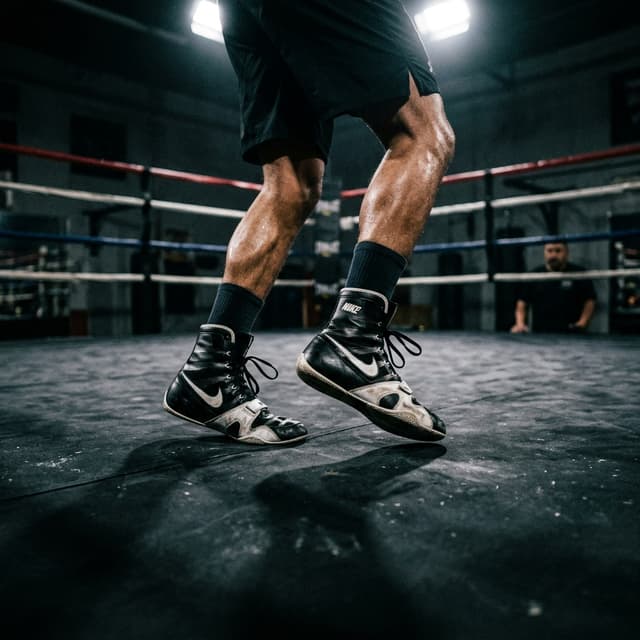
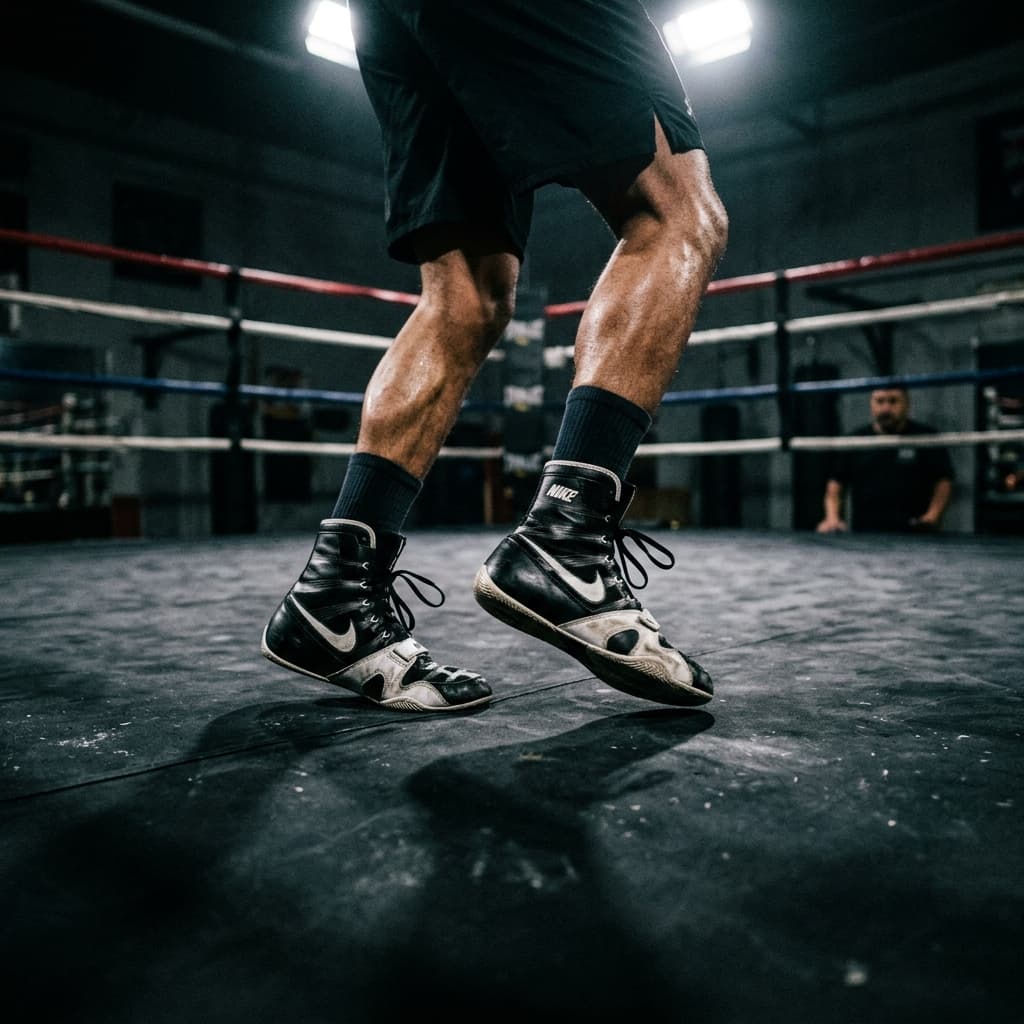
The pendulum step is a rhythmic bouncing motion on the balls of the feet. It keeps you light, mobile, and ready to move in any direction at any time. If the step-drag is how you get from point A to point B, the pendulum step is how you stay ready to go anywhere.
Think of it as your "idle state" — you are never flat-footed, never static. Your weight transfers subtly back and forth between the lead and rear foot in a constant rhythm, like a pendulum swinging. This pre-loading of weight means you can push off in any direction without needing to first shift your weight to the pushing foot — you are always already in position to move.
The bounce comes from the calves and ankles, not from jumping. Your head should barely move up and down — if your head is bobbing noticeably, you are bouncing too high and wasting energy. It is a subtle, energy-efficient rhythm that lets you explode in any direction when you need to. Thomas Hearns used a pronounced pendulum step to control distance at range, rocking slightly back and forth to keep himself just outside his opponent's reach while staying close enough to lance his jab whenever an opening appeared.
Lomachenko's version is so subtle it is barely visible to the naked eye — but it is always there. His feet never go flat. Watch him in slow motion and you will see the constant micro-adjustments in weight distribution that allow him to change direction mid-step, something flat-footed fighters simply cannot do.
Biomechanically, the pendulum step keeps your stretch-shortening cycle primed. Your calf muscles and Achilles tendons store elastic energy during each subtle bounce, and that stored energy is immediately available when you need to push off explosively. It is the same principle that makes a basketball player bounce on their toes at the free-throw line — staying in motion makes the next explosive movement faster and more efficient than starting from a dead stop.
Common Footwork Mistakes
Standing flat-footed is the most common mistake — and the hardest to fix because it feels comfortable. When you stand flat-footed, your heels bear weight, your calves disengage, and you lose the ability to push off quickly. Every movement requires a preliminary shift onto the balls of the feet before you can actually step, which adds a split second of delay to every action. In a sport measured in fractions of seconds, that delay is the difference between slipping a punch and taking it on the chin. George Foreman in his later career was often flat-footed, but he had a granite chin and devastating power to compensate — you probably do not.
Crossing your feet during lateral movement is dangerous and surprisingly common, especially when beginners try to circle away from pressure. A single push, a single body shot, even a glancing hook to the shoulder, and you are on the floor because your base has been eliminated. Amir Khan was notorious for crossing his feet under pressure, and it contributed to several of his knockdown losses.
Taking too-large steps kills your balance and makes you slow to change direction. Each large step requires a recovery period before the next step, creating a rhythm your opponent can time. It also tends to bring your feet together at the midpoint of the step, temporarily eliminating your base.
Bouncing too high wastes energy and makes your head predictable. If you are bouncing three inches off the floor, your opponent can time punches to land at the peak of your bounce when you are airborne and cannot move. Keep it subtle — half an inch to an inch of heel lift is sufficient. Your feet should whisper across the canvas, not stomp.
Watching your own feet is a beginner reflex that disappears with training but needs to be actively corrected. The moment you look down to check your footwork, you lose sight of your opponent's hands. Train footwork patterns until they are automatic, then keep your eyes up.
Footwork Drills You Can Do Alone
You do not need a partner for these drills, and they can be done in any space large enough to move four steps in each direction. Consistent daily practice — even just 10 minutes — produces noticeable improvement within two weeks.
The jump rope is the single best footwork tool in boxing. Period. It develops calf endurance, ankle stability, timing, coordination, and the light-footed rhythm that transfers directly to ring movement. Every boxing gym in the world has jump ropes for a reason. Start with three-minute rounds (matching fight round length) and build to five or six rounds. Once basic bouncing feels easy, add variations: side-to-side hops, front-to-back hops, single-leg hops, and high knees. Floyd Mayweather Jr.'s jump rope routines are legendary — he can do it for 30 minutes straight while maintaining conversations.
Ladder drills develop coordination and speed through the feet. If you do not have an agility ladder, use tape on the floor or simply imagine the squares. The in-in-out-out pattern (both feet in each square, then both feet outside) is the most boxing-relevant because it mimics the step-drag rhythm.
Shadow boxing for movement only: Do three rounds focusing only on movement — no punches, just step-drags, pivots, and directional changes. Move forward four steps, backward four steps, lateral four steps each direction, then mix them. This forces you to drill the footwork patterns without the distraction of thinking about your hands.
Cone drills: Set up four cones in a square about six feet apart and move between them, practicing forward, backward, and lateral movement while maintaining your stance. The rule: your feet must stay in your boxing stance orientation at all times. No turning to face the direction you are moving — you must step-drag.
The pivot drill: Stand in your stance and practice 45-degree and 90-degree pivots off both the lead and rear foot. A pivot off the lead foot takes you to a new angle while keeping the same distance from your opponent — this is the fundamental escape move when you are pressured against the ropes. Lomachenko's signature move is a pivot off the lead foot that takes him to his opponent's blind side, and it starts with exactly this drill.
See these techniques broken down by featured creator Coach Josh.
Learn the complete footwork system
The Boxing Blueprint is a 4-part video course covering fundamentals, conditioning, footwork, and fight strategy.
View The Boxing BlueprintReady to Practice?
Put what you learned into action with a guided shadowboxing session or timed heavy bag workout.