Why Stance Matters More Than Any Punch
Here is something most beginners do not realize: a perfect cross thrown from a broken stance has no power. A mediocre jab thrown from a solid stance lands clean.
Your stance is not just where you put your feet. It is the foundation of the entire kinetic chain — the sequence of energy transfer that starts at the floor, travels through your legs, rotates through your hips, and arrives at your fist. When your stance is broken, that chain is broken, and every punch you throw is an arm punch with no real authority behind it.
Watch Canelo Alvarez. His feet are always set before he throws. He is never reaching, never off-balance, never caught with his weight on the wrong foot. That is not natural talent — it is thousands of hours of drilling the stance until it became automatic. Now watch a beginner spar for the first time: feet too close, weight shifting unpredictably, stumbling after every exchange. The difference is the stance.
Your stance gives you balance, power, defense, and the ability to move in any direction. It is what lets you absorb a punch without falling, throw a punch without leaning, and move without crossing your feet. Ask any coach what they fix first. The answer is always the feet.
Orthodox vs. Southpaw
If you are right-handed, you will typically fight "orthodox" — left foot forward, right hand in the rear. Left-handed fighters usually stand "southpaw" — right foot forward, left hand in the rear. The logic is straightforward: your dominant hand sits in the rear position where it can generate maximum rotational power on the cross and overhand.
The lead hand jabs. The rear hand delivers power. Your lead foot controls distance and angles. Your rear foot is the anchor that drives rotation.
There are notable exceptions that prove the rule. Marvin Hagler was a natural right-hander who fought southpaw — and he could switch stances mid-combination, which made him one of the most difficult fighters of his era to prepare for. Miguel Cotto, a natural righty, occasionally switched to southpaw to find better angles against certain opponents. Oscar De La Hoya, another right-hander, used a southpaw stance at times against Mayweather to try to neutralize the Philly Shell.
But when you are learning, go with your dominant hand in the back. You need to build one solid stance before you experiment with switching. If you are genuinely ambidextrous and unsure, try both in shadow boxing for a week — the one that feels more natural for throwing the jab is your lead side.
Setting Up Your Stance Step by Step
A good boxing stance balances offense and defense. You want to be able to punch, move, and defend without needing to reset your feet. The specific measurements here are starting points — your body proportions and fighting style will refine them over time, but these fundamentals have held true across every era of the sport.
Biomechanically, you are creating a stable base with a low center of gravity while keeping enough mobility to explode in any direction. Think of it like an athletic ready position in basketball or tennis — you are loaded, springy, and ready to react. Juan Manuel Marquez was famous for his textbook stance: compact, balanced, and always ready to counter. Floyd Mayweather Sr. drills this positioning into every fighter he trains, starting from day one.
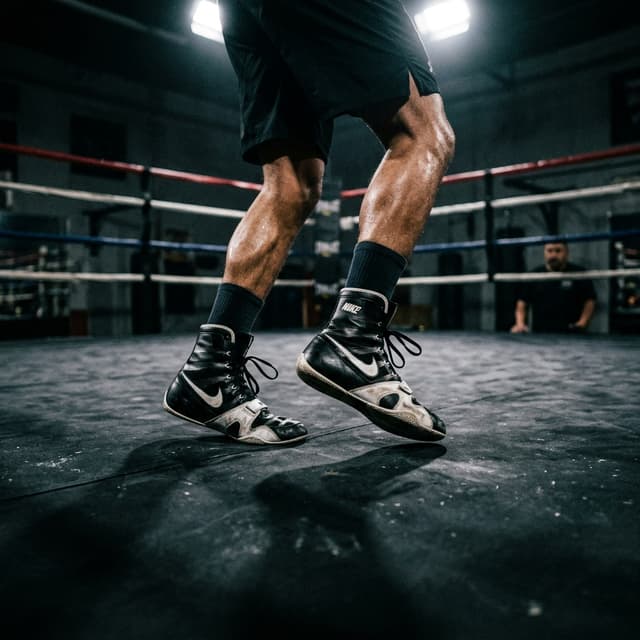
Stand with your feet shoulder-width apart, lead foot pointing toward your opponent. The width gives you lateral stability — too narrow and you tip sideways, too wide and you lose mobility.
Stagger your feet so your rear foot is roughly 18 inches behind your lead foot, turned outward at about 45 degrees. This stagger gives you front-to-back stability and loads the rear hip for rotational power.
Bend your knees slightly — not a deep squat, just enough to feel athletic and springy. Think about a 15-20 degree bend. This lowers your center of gravity and stores elastic energy in your legs.
Keep your weight distributed roughly 50/50 between both feet, slightly favoring the balls of the feet. Heels can touch the floor but should not bear significant weight — you need to be ready to push off instantly.
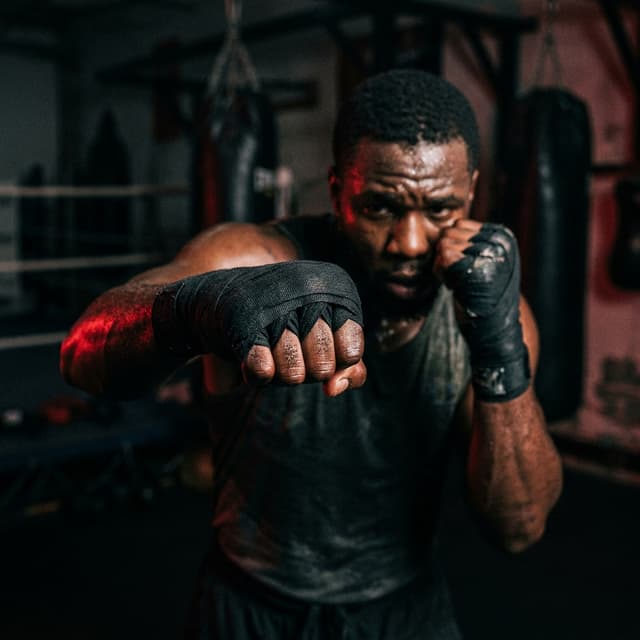
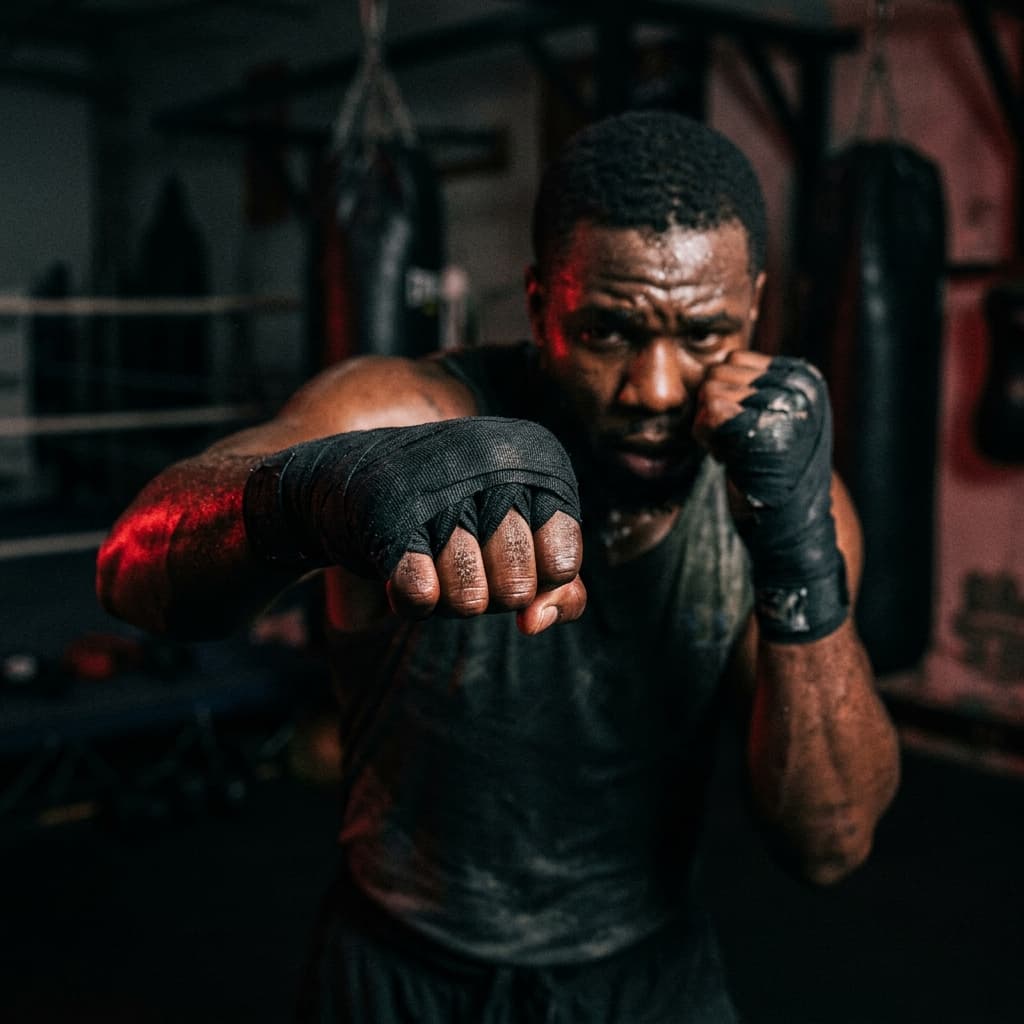
Hands up: lead hand at cheekbone height, rear hand touching your chin. Elbows tucked tight against your ribs to protect the body. Your forearms should create a vertical wall in front of your torso.
Chin down, eyes up. Look through your eyebrows, not over them. Tucking the chin shortens the lever arm on your neck, making you significantly harder to knock out. This is non-negotiable.
The Three Most Common Stance Mistakes
Standing too square exposes both sides of your body and presents your liver, spleen, and solar plexus as open targets. Ricky Hatton, a pressure fighter who sometimes squared up during exchanges, got knocked out by Manny Pacquiao's left hand partly because his square stance left him wide open on the right side.
Standing too bladed (turned sideways) takes away your lead hook and limits you to straight punches. If you are turned completely sideways, your lead hip cannot rotate into a hook — you physically do not have the range of motion. This also makes you vulnerable to body shots on the exposed side of your torso that faces the opponent.
Feet too close together? You have no base. The first solid shot you take will push you off balance. Feet too far apart? You are planted and immobile — you cannot step quickly in any direction, and your legs fatigue faster because they are working harder to hold the wide position.
The sweet spot is a staggered, slightly bladed position — roughly 30-45 degrees turned from square — where you can throw every punch in the book without needing to reset. Your lead shoulder should point generally toward the opponent, presenting a narrow target while keeping both hips available for rotation.
One more critical mistake: rising up on the toes too much. Some beginners bounce so high on their toes that they lose all stability. Your heels should hover just above the floor, not float inches off it. Watch Vasyl Lomachenko — his feet barely leave the ground, yet he moves faster than anyone in the sport.
Testing Your Stance
Here is a quick self-check you can do right now that every trainer worth their salt uses on day one.
From your stance, have someone push you from the front, from the side, and from behind. If you stumble in any direction, your base is too narrow or your weight distribution is off. You should be able to absorb a moderate push from any angle without moving your feet. That is a fight-ready stance.
The shadow boxing test: Throw a hard jab, a hard cross, a lead hook, and a rear uppercut — all from your stance without resetting your feet between punches. If any of those punches pulls you off balance, adjust your width or weight distribution until all four feel stable.
The movement test: From your stance, take one quick step in each direction — forward, back, left, right. You should arrive in a balanced position after every step, with your stance width maintained. If your feet come together or you feel off-balance after stepping, you are standing too narrow or too wide.
The mirror test: Stand in your stance and look at yourself from the side. Your spine should be roughly vertical, not leaning forward or backward. Your shoulders should be stacked over your hips. If you are leaning forward, you will fall into punches. If you are leaning back, you cannot generate offensive power. Train this position until it feels like home — because in the ring, your stance is the only thing you can always come back to.
See these techniques broken down by featured creator Coach Josh.
Master all the fundamentals in one structured course
The Boxing Blueprint is a 4-part video course covering fundamentals, conditioning, footwork, and fight strategy.
View The Boxing BlueprintReady to Practice?
Put what you learned into action with a guided shadowboxing session or timed heavy bag workout.