Why the Jab Is the Most Important Punch in Boxing
Ask any boxing coach which punch to learn first. The answer is always the same: the jab.
Larry Holmes built a Hall of Fame career on the back of what many consider the greatest jab in heavyweight history. His jab was so sharp and persistent that it broke down Ken Norton's guard over fifteen rounds — a fighter nobody else wanted to face. Muhammad Ali used a piston-like jab to control distance against every opponent he faced, dictating the pace from the outside against bigger, stronger punchers like Sonny Liston and George Foreman. Lennox Lewis made the jab look like a weapon of its own, spearing Vitali Klitschko repeatedly from the outside and opening cuts that eventually stopped the fight.
The jab is not about power. It is about control — controlling distance, breaking your opponent's rhythm, and creating the openings for everything else you throw. Biomechanically, the jab travels the shortest distance of any punch, which means it arrives first and recovers first. It is the punch you can throw fifty times a round without gassing out, the punch that sets your opponent's guard high so you can dig to the body, and the punch that keeps an aggressive fighter from walking you down. Without a jab, you have no range finder. Without a range finder, your power shots are guesses.
The Mechanics of a Proper Jab
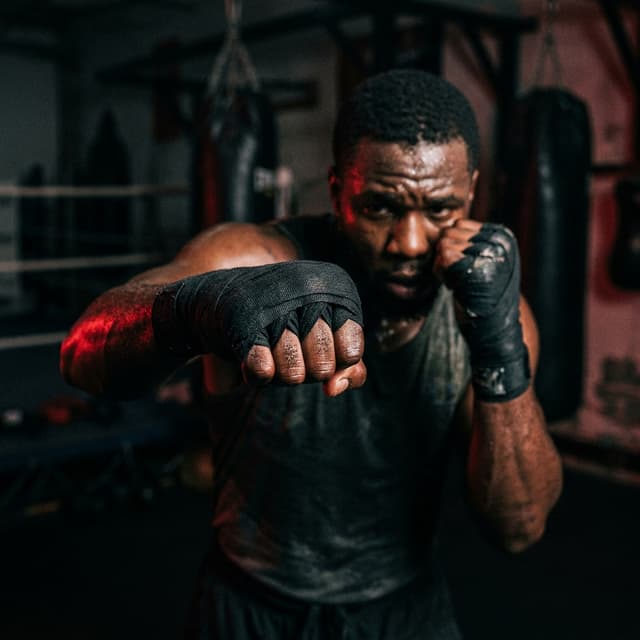
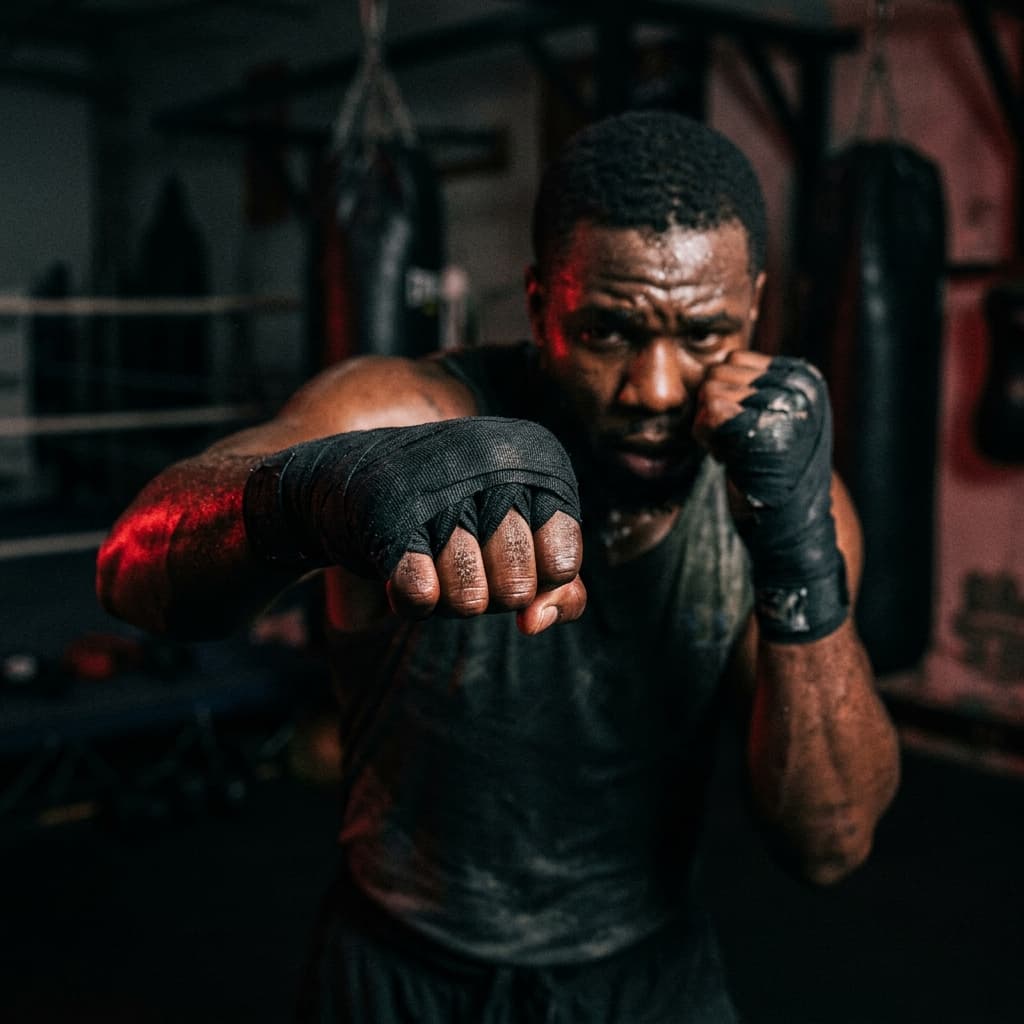
The jab starts from your guard position. Your lead hand sits just below your cheekbone, elbow tucked tight. Understanding the biomechanics here matters — the power in a jab does not come from the arm alone. It originates from a subtle weight transfer through the kinetic chain: rear foot pushes into the floor, hips shift forward a fraction, and the shoulder drives the fist out like a piston.
The punch travels in a straight line — from your chin to the target and back again. Same path in, same path out. Many beginners loop the jab outward in a small arc, which adds travel time and telegraphs the punch. Think of your fist riding a rail straight to the target. The rotation of the forearm — pronating so the palm faces down at impact — adds a corkscrew effect that tightens the fist and aligns the two large knuckles (index and middle) with the forearm bones, creating a more structurally sound impact surface.
The shoulder lift is not optional. When your lead shoulder rises to meet your chin as the arm extends, it creates a physical shield against counter crosses — the exact punch your opponent wants to throw when they see your jab coming. Watch how Terence Crawford lifts his shoulder on every jab; it is a built-in defense within the offense.
Here is the full sequence:
Start in your boxing stance with hands up and elbows tucked tight to the body.
Push off the ball of your rear foot and shift your weight slightly forward — the push generates force through the ground.
Extend your lead arm straight out, rotating the fist so the palm faces down at impact. The rotation should complete in the final six inches before contact.
Lift your lead shoulder to protect your chin as the arm extends — this is your built-in defense against counter shots.
Snap the hand back to your guard along the exact same path it traveled out. The retraction should be just as fast as the extension, if not faster.
Three Mistakes Beginners Make
Good news: the three most common jab mistakes are all fixable in a single training session once you know what to look for. The bad news is that if you do not fix them early, they become deeply grooved habits that take months to undo under pressure.
The first mistake — dropping the rear hand — is the one that gets beginners hurt in sparring. Your brain wants to use both arms for the effort of punching, so the rear hand drifts down sympathetically. A coach watching Manny Pacquiao's early knockouts can point to the exact moment his opponents dropped their right hand while jabbing — and Pacquiao's left cross arrived before they even realized it was gone.
The second mistake, elbow flare, is a biomechanical inefficiency that also functions as a telegraph. When the elbow kicks outward before the fist extends, the punch traces a wider arc, adding both travel time and a visual cue your opponent can read. Fix this by standing sideways to a wall and jabbing — if your elbow hits the wall, you are flaring.
The third mistake is the lazy return. Leaving the hand out after the jab is an invitation to be countered. Your opponent can parry the extended arm, trap it, or simply fire over it. The retraction is half the punch. Train yourself to think of the jab as a whip crack — out and back at the same speed.
Dropping the rear hand while jabbing — this leaves your chin wide open. Keep that hand glued to your cheek. Practice jabbing with a tennis ball tucked under your rear arm to build the habit.
Flaring the elbow out before extending — this "telegraphs" the punch, meaning your opponent sees it coming before it arrives. Shadow box next to a wall to check.
Leaving the hand out instead of snapping it back — a lazy jab is a caught jab. Bring it home fast. Think "touch the target, touch your cheek" as one continuous motion.
Jab Variations You Need to Know
Once your basic jab feels solid, these variations open up your entire game. Each serves a distinct tactical purpose, and the best jabbers in history used all of them.
The double jab fires the second jab before the first hand fully returns. It disrupts your opponent's timing and creates openings they were not expecting. Larry Holmes would throw a single jab for two rounds, then start doubling it in the third — his opponents would time the single jab and walk right into the second one. The key to the double jab is keeping the shoulder elevated on both shots; most beginners drop the shoulder between jabs and lose the protective shield.
The body jab drops your level by bending the knees (never the waist) and targets the midsection — the soft area just below the chest. Bending at the waist instead of the knees is a critical error that puts your head at uppercut height. Gennady Golovkin was a master of the body jab, using it to slow down opponents and force them to lower their guard, which opened up his devastating right hand upstairs.
The flicker jab, made famous by Thomas Hearns, is thrown from a lower guard with a whipping motion. It prioritizes speed over power and is surprisingly hard to defend because of the unusual angle and the lack of a traditional loading motion. Hearns would flick it almost lazily from his hip, but it carried enough snap to keep opponents at range and set up his nuclear right hand.
The power jab is thrown with a full step forward and significant weight transfer. It is closer to a straight left than a traditional jab. Wladimir Klitschko used this variation to keep opponents at the end of his enormous reach, and he landed it with enough force to buckle knees. The trade-off is recovery time — a power jab commits your weight forward, making it harder to pull back quickly.
How to Train Your Jab
A sharp jab comes from consistent volume. You need to throw thousands of jabs before it becomes reflexive — an automatic response rather than a conscious decision. Here is a progressive training plan that builds from basic repetition to fight-applicable speed and timing.
Shadow boxing (3 rounds, jab only): Focus exclusively on the jab for three full rounds. Mix single jabs, double jabs, jab-step combinations, and body jabs. Watch yourself in a mirror and check for elbow flare, hand drop, and shoulder lift. This is your diagnostic tool — if it looks wrong in shadow boxing, it will be worse under pressure.
Heavy bag burnouts (30-second intervals): Set a timer for 30 seconds and throw maximum-speed jabs at the heavy bag. Your anterior deltoid — the front of the shoulder — will burn intensely by the third interval. That is the point. This builds the muscular endurance needed to keep your jab active in the championship rounds. Do six intervals with 30 seconds of rest between each.
Resistance band jabs (100 reps per side): Loop a resistance band behind your back and hold one end in your lead hand. Throw 100 jabs against the resistance. This builds the specific pushing strength through the same range of motion your jab uses. After removing the band, throw 20 free jabs — they will feel noticeably faster, a phenomenon called post-activation potentiation.
Double-end bag work (2 rounds): The double-end bag bounces back unpredictably, forcing you to time your jab against a moving target and immediately reset your guard. This is the closest simulation to jabbing a live opponent without actually sparring.
Partner drill — jab sparring: Both fighters use only the jab for a full round. No other punches allowed. This teaches you how to land your jab against real defensive reactions and how to avoid your opponent's jab using head movement and footwork. It is the single best jab-development drill and a staple of gyms that produce sharp technical fighters.
See these techniques broken down by featured creator Coach Josh.
Learn the complete boxing fundamentals system
The Boxing Blueprint is a 4-part video course covering fundamentals, conditioning, footwork, and fight strategy.
View The Boxing BlueprintReady to Practice?
Put what you learned into action with a guided shadowboxing session or timed heavy bag workout.