Why the 1-2 Works at Every Level
From your first day in the gym to world championship fights, the jab-cross is the bread and butter combination. Deontay Wilder knocked out 41 professional opponents, and the majority of those finishes started with some variation of the 1-2. Canelo Alvarez uses it to close distance before launching hooks. Terence Crawford sets up switches and angles off of it. The combination is universal because the biomechanics are universal.
Why does it work so well? Because the first punch sets up the second through a principle called sequential loading. The jab finds the range, occupies the opponent's vision, and forces their guard to react. As you retract the jab, the rotation of your torso naturally pre-loads the rear hip and shoulder for the cross. The cross then arrives through the opening before the opponent can reset their guard — they are still processing the jab when the power shot lands.
It is simple. It is reliable. And it works at every level of the sport because human reaction time has a hard floor. Even elite fighters need roughly 200 milliseconds to react to a visual stimulus. A well-timed 1-2, where the cross follows the jab within 150-250 milliseconds, exploits that biological limitation. The opponent's brain is still telling their hands to deal with the jab when the cross is already in flight.
Breaking Down the Mechanics
The 1-2 is not two separate punches thrown back-to-back. It is a single fluid sequence where pulling back the jab loads the cross. Understanding this connection is the difference between a combination that flows and one that feels disjointed.
Biomechanically, the jab retraction rotates your lead shoulder backward, which simultaneously rotates your rear shoulder forward. This rotation stores elastic energy in your core — specifically in the obliques and the muscles around the thoracic spine. The cross then releases that stored energy, driving the rear hand forward with the full rotational force of the hips and torso behind it.
The rear foot pivot is where the power originates. Think of your rear foot as a corkscrew drilling into the ground — the ball of the foot stays planted while the heel rotates outward. This forces your knee inward, which forces your hip to rotate, which forces your torso to rotate, which drives the shoulder and arm forward. The kinetic chain runs from the ground up. If any link is missing — flat rear foot, stiff hips, no torso rotation — you get an arm punch with a fraction of the potential force.
Watch Thomas Hearns throw the 1-2. His rear foot pivot is so pronounced that his heel lifts completely off the canvas. That extreme rotation is what generated the terrifying power that knocked out Roberto Duran in two rounds.
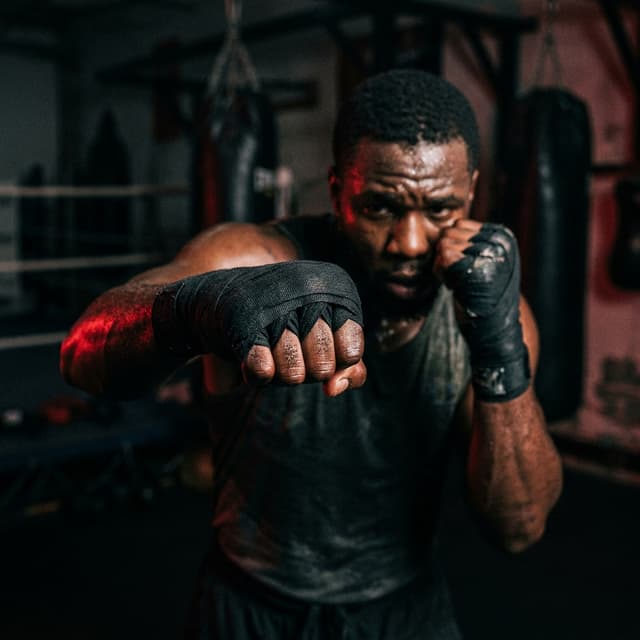
Throw the jab — full extension, shoulder to chin, snap it back. The retraction begins loading your cross.
As the jab returns, begin pivoting your rear foot and rotating your hips. The pivot should feel like you are squashing a bug with the ball of your rear foot.
The cross follows immediately — the rear hand drives straight down the center line. Do not loop it. The shortest distance between two points is a straight line.
Rotate your rear shoulder forward until it touches your chin for protection. This full rotation also ensures you are transferring maximum force.
Return both hands to guard. Do not admire your work. The two most dangerous moments in a fight are right after you land and right after you miss.
Timing and Rhythm
Here is a detail that separates a good 1-2 from a great one: the timing between the jab and cross should not be evenly spaced.
Throw the jab at a measured speed. Then accelerate the cross. The change in rhythm makes it much harder to defend because the opponent's brain calibrates to the speed of the first punch and expects the second to arrive at the same tempo. When the cross comes faster, their defensive response is late.
Think of it as "tap... BANG." The jab is the question. The cross is the answer.
Manny Pacquiao was a master of this rhythmic deception. He would throw a relaxed, almost lazy jab, then detonate the left straight (his power hand from the southpaw stance) at maximum velocity. Opponents knew it was coming and still could not time it because the speed differential between the two punches was so dramatic.
You can also reverse this pattern occasionally — throw a fast, snappy jab followed by a deliberate, heavy cross. This variation works because the opponent times the speed of the jab and flinches early, then relaxes before the cross arrives. Unpredictable rhythm is your greatest weapon. The moment your 1-2 becomes metronomic, your opponent can time it and counter.
Setting Up the 1-2
A raw 1-2 thrown in open air gets blocked by anyone with basic defense. The key is the setup — creating the conditions where your opponent's guard is compromised before you launch the combination.
The most reliable setup is pattern establishment. Throw several single jabs in the first round to establish a predictable rhythm. Your opponent's brain learns: "jab, reset, jab, reset." Then, in the second round, let the cross follow one of those jabs. The opponent was expecting just the jab — the cross arrives in the space where they were preparing to counter the single punch.
Another option: step slightly to the outside of the opponent's lead foot as you throw. That small angle change means the cross arrives from outside their field of vision. This is called stepping to the "blind side," and it is the reason Andre Ward's 1-2 was so difficult to defend — he always created a subtle angle before throwing it.
The feint setup is equally effective. Twitch your lead shoulder without actually throwing the jab. If the opponent reacts — a flinch, a parry attempt, any hand movement — their guard is momentarily disrupted. Throw the real 1-2 immediately after the feint. Vasyl Lomachenko uses this technique constantly, feinting two or three times before committing to the actual combination.
Body-to-head setup: Throw a jab to the body first, which pulls the opponent's guard downward. Follow immediately with the 1-2 upstairs. Their hands are low from dealing with the body jab, and the cross arrives at an unprotected chin.
What Comes After the 1-2
The 1-2 is a launching pad, not the whole combination. Understanding what flows naturally after the cross is what turns a two-punch sequence into a devastating offensive series.
After the cross lands, your body is naturally loaded for a lead hook — your weight has shifted forward and your lead hip is coiled. That gives you the classic 1-2-3 (jab-cross-hook), which is the most commonly thrown three-punch combination in professional boxing. Gennady Golovkin built his entire offensive identity around this sequence, and the hook at the end carried enough force to end fights at middleweight.
You can also follow with a body shot — either a hook to the liver (if you are orthodox fighting another orthodox) or a cross to the body. Dropping the level after head punches is disorienting for the opponent and opens up angles they were not defending.
The pull-back and reset is an underrated option. Not every combination needs a third punch. Sometimes the smartest play is to land the 1-2, pull straight back out of range, and make the opponent miss their counter. Floyd Mayweather Jr. made a career out of the 1-2-pull — landing clean and being gone before the return fire arrived.
The one rule: never stand in the pocket after throwing. Move your head or move your feet after every combination. The most dangerous moment in boxing is the half-second after you finish throwing — that is when counter punches land. Either exit with lateral movement, pull back, or roll under the expected counter. Standing still after a combination is how fighters get knocked out, regardless of how clean their shots landed.
See these techniques broken down by featured creator Coach Josh.
Learn the full combination system
The Boxing Blueprint is a 4-part video course covering fundamentals, conditioning, footwork, and fight strategy.
View The Boxing BlueprintReady to Practice?
Put what you learned into action with a guided shadowboxing session or timed heavy bag workout.