Shadow Boxing Is Real Training
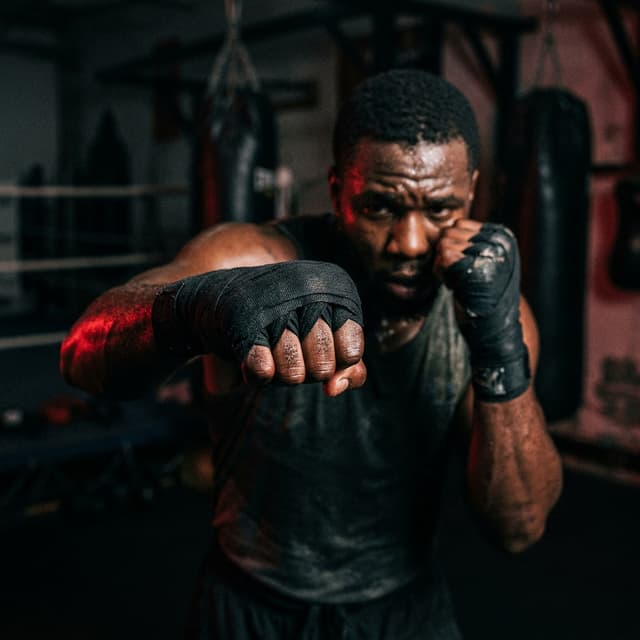
Let's kill a myth right now: training at home without equipment isn't a compromise. Shadow boxing is one of the most valuable drills in the sport, and every elite fighter on the planet does it regularly — not as a warm-up afterthought, but as focused, technical work.
Vasyl Lomachenko shadow boxes obsessively, often in front of a mirror, refining angles and footwork patterns that make him virtually unhittable. Manny Pacquiao's trainers have said his shadow boxing rounds are some of the most intense parts of his camp. Floyd Mayweather Jr. famously shadow boxed for 30+ minutes straight, working combinations and defensive sequences with the same precision he brought into the ring.
Why? Because shadow boxing forces you to generate your own resistance. There's no bag to lean on, no partner to react to. You have to visualize, maintain balance, and self-correct in real time. It builds coordination, cardio, and muscle memory simultaneously.
This workout is structured like a real boxing session: 6 rounds with active rest periods. It's designed to be done in a small space — even a 6x6 foot area works. No equipment. No excuses. Just you and the work.
Before You Start: Setup & Ground Rules
Clear your space. Move the coffee table. Push the chairs back. You need enough room to throw a full cross without hitting a lamp. A 6x6 foot area is the minimum. 8x8 is ideal.
Wear shoes or go barefoot on a non-slip surface. Socks on hardwood is a recipe for a blown-out knee. Training shoes with flat soles work best. If you're barefoot, make sure the floor has some grip.
Set a timer. Use your phone or a free round timer app. Each round is 3 minutes with 30 seconds rest between rounds. That's the standard boxing format. If you're a true beginner, start with 2-minute rounds and 1-minute rest.
Hydrate before, during, and after. Keep water within arm's reach. Sip between rounds — don't chug.
Total workout time: ~25 minutes (6 rounds + rest + cool down)
Space needed: 6x6 feet minimum
Equipment: None (timer app recommended)
Difficulty: Beginner to intermediate (scales with intensity)
Round 1: Technical Shadow Boxing
This round is about precision, not power. Start in your boxing stance — lead foot forward, hands up, chin tucked, weight balanced. Throw single shots with full extension and proper hip rotation. Focus on one punch at a time.
First minute: Jabs only. Step and jab. Double jab. Jab to the body, jab to the head. Focus on snapping the punch back to your guard. Every jab should start and end at your chin.
Second minute: Add the cross. Work the basic one-two combination. Step forward with the jab, rotate your hips fully on the cross. Feel your rear foot pivot. Reset your stance after every combination — don't let your feet get lazy.
Third minute: Mix in the lead hook. Jab-cross-hook. Jab-hook. Double jab-cross-hook. Keep the hook tight — elbow at 90 degrees, turn your lead hip and foot. The power comes from the rotation, not the arm.
The goal here is to warm up your nervous system and groove your mechanics. If you're breathing hard by the end, you were probably muscling your punches. Relax your shoulders. Snap, don't push.
Round 2: Footwork & Defense Shadow Boxing
Round 2 shifts focus to movement and defensive responsibility. You're not just throwing — you're moving before, during, and after every combination.
Throw a combination, then move. Jab-cross, then pivot left. One-two-hook, then step back. This is how real boxing works — you punch and then you're not there anymore. Stand-and-trade is for highlights, not for winning.
Add defensive moves between combinations. Throw a jab, slip outside, come back with a cross. Throw a one-two, bob and weave under an imaginary hook, fire back with a hook of your own. Visualize an opponent returning fire after every combination you throw.
Work the angles. Step to your left after a combination. Pivot off your lead foot to a new angle. Practice the L-step: step your lead foot to the side, then bring your rear foot to re-establish your stance at a new angle. This is the footwork that separates fighters who get hit from fighters who don't.
Small space adjustment: If your room is tight, focus more on pivots and slips rather than lateral movement. You can fight effectively in a phone booth if your upper body defense and pivots are sharp. Mike Tyson proved that.
Rounds 3 & 4: Bodyweight Conditioning
Now we build the engine. These two rounds are pure conditioning — the kind of explosive, full-body work that mirrors the energy demands of actual fighting. Boxing isn't jogging. It's repeated bursts of high-intensity effort with brief recovery. Train accordingly.
Round 3 — Power Circuit (3 minutes, continuous):
Cycle through these exercises with no rest between them. Go at 80% effort — hard enough that you're breathing heavy, controlled enough that your form stays clean.
Squat jumps (30 seconds): Feet shoulder-width, squat to parallel, explode up. Land soft. These build the leg drive that powers your cross and hooks. Every punch starts from the ground — weak legs mean weak punches.
Push-ups (30 seconds): Standard push-ups, chest to the floor. These build the pushing endurance your shoulders need to keep your hands up in the late rounds. If standard push-ups are too easy, try explosive push-ups where your hands leave the floor.
Mountain climbers (30 seconds): Plank position, drive knees to chest alternately at a fast pace. This is core and cardio simultaneously — exactly the combination you need for boxing.
Repeat the cycle until the round ends. That's roughly 3 full cycles.
Round 4 — Fight Simulation Circuit (3 minutes, continuous):
Burpees (30 seconds): The single best conditioning exercise for fighters. Full burpee — drop to the floor, chest down, push up, jump. This simulates getting knocked down and getting back up. It trains your body to recover under fatigue, which is exactly what happens in a real fight.
Fast feet / high knees (30 seconds): Light on your toes, pump your knees up. This maintains the fast-twitch responsiveness you need to cut angles and react to punches.
Shadow boxing flurries (30 seconds): Throw non-stop combinations at about 70% power. Jab-cross-hook-cross, jab-jab-cross-hook-uppercut — whatever comes naturally. The goal is sustained output, keeping your hands moving when your lungs are screaming.
Repeat the cycle. By the end of Round 4, your shirt should be soaked.
Squat jumps: Build explosive leg drive for punching power
Push-ups: Shoulder endurance to keep your guard up
Mountain climbers: Core strength + cardio in one movement
Burpees: Full-body fight simulation — the king of boxing conditioning
Shadow boxing flurries: Sustained punch output under fatigue
Round 5: Core & Trunk Rotation
Your core is the transmission between your legs and your fists. Every punch travels through it. Every slip depends on it. A weak core means leaked power and a vulnerable body.
This round is continuous — no rest within the round.
Plank hold (45 seconds): Forearms on the ground, body straight as a board. Squeeze your glutes, brace your abs. Don't let your hips sag. This builds the isometric core strength that keeps you stable when you throw and when you get hit.
Russian twists (45 seconds): Sit on the floor, lean back at 45 degrees, feet off the ground. Rotate your torso side to side, touching the floor on each side. This directly mimics the trunk rotation you use for hooks and uppercuts. Keep the movement controlled — speed without control is useless.
Bicycle crunches (45 seconds): Opposite elbow to opposite knee, alternating sides. Full extension of each leg. This trains the obliques and hip flexors together — the exact muscles that fire when you throw a hook to the body or slip a punch.
Dead bugs (45 seconds): Lie on your back, arms extended toward the ceiling, knees at 90 degrees. Lower opposite arm and leg simultaneously while pressing your lower back into the floor. This is anti-extension core training — it teaches your core to resist movement, which is what keeps you balanced when you miss a power shot.
Round 6: Freestyle Shadow Boxing
Last round. This is where you put it all together.
Fight an imaginary opponent for 3 minutes. Move like it's real. Throw combinations, slip, pivot, change levels. Start at mid-range, work your way in with jabs, land a combination, move out. Visualize your opponent throwing back — react to it.
First minute: Establish your jab. Move your feet. Control distance. Think Lennox Lewis — long, measured, picking your shots.
Second minute: Increase the pressure. More combinations, shorter rest between bursts. Work the body. Throw a jab to the head, cross to the body. Mix levels — that's what makes a fighter hard to read.
Final minute: Championship round mentality. Empty the tank. This is where you build mental toughness. Your arms are heavy, your lungs burn, and you keep throwing. In a real fight, this is the round that separates winners from losers. Practice finishing strong.
When the bell rings, put your hands down and walk it off. You earned it.
Cool Down & Recovery
Don't skip this. Five minutes of cool-down work dramatically reduces soreness and improves recovery between sessions.
Walk in place or around your space for 1-2 minutes. Let your heart rate come down gradually. Going from max effort to sitting on the couch is a shock to your cardiovascular system.
Static stretching (3 minutes): Now — and only now — is the time for static stretches. Hold each for 20-30 seconds.
Shoulder cross-body stretch (both sides)
Tricep overhead stretch (both sides)
Hip flexor lunge stretch (both sides)
Hamstring stretch — straight leg, reach for your toes
Chest opener — clasp hands behind your back, pull shoulder blades together
Neck rolls — slow, controlled circles in both directions
Scaling the Workout
Beginner: Use 2-minute rounds with 1-minute rest. In the conditioning rounds, reduce to 20-second intervals instead of 30. Skip the burpees and substitute squat holds or step-backs.
Intermediate: Follow the workout as written — 3-minute rounds, 30-second rest. Push for consistent output across all 6 rounds.
Advanced: Increase to 3-minute rounds with only 15 seconds rest. Add a 7th round of pure shadow boxing. In the conditioning rounds, increase intervals to 45 seconds. Add plyometric push-ups and tuck jumps.
Do this workout 3-4 times per week and you'll build the conditioning base that makes everything else in boxing easier. Your hands stay up longer. Your footwork stays sharp deeper into rounds. Your recovery between combinations improves. And when you finally get to the gym and hit a bag or spar, you'll notice the difference immediately.
Equipment is nice. Gyms are great. But the most important piece of boxing equipment is your own body — and you've always got that.
See these techniques broken down by featured creator Coach Josh.
Build your complete boxing foundation with our structured course
The Boxing Blueprint is a 4-part video course covering fundamentals, conditioning, footwork, and fight strategy.
View The Boxing BlueprintReady to Practice?
Put what you learned into action with a guided shadowboxing session or timed heavy bag workout.