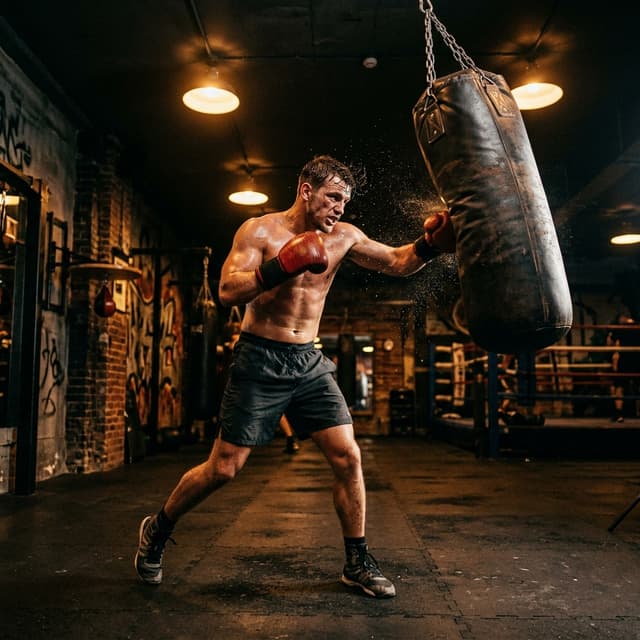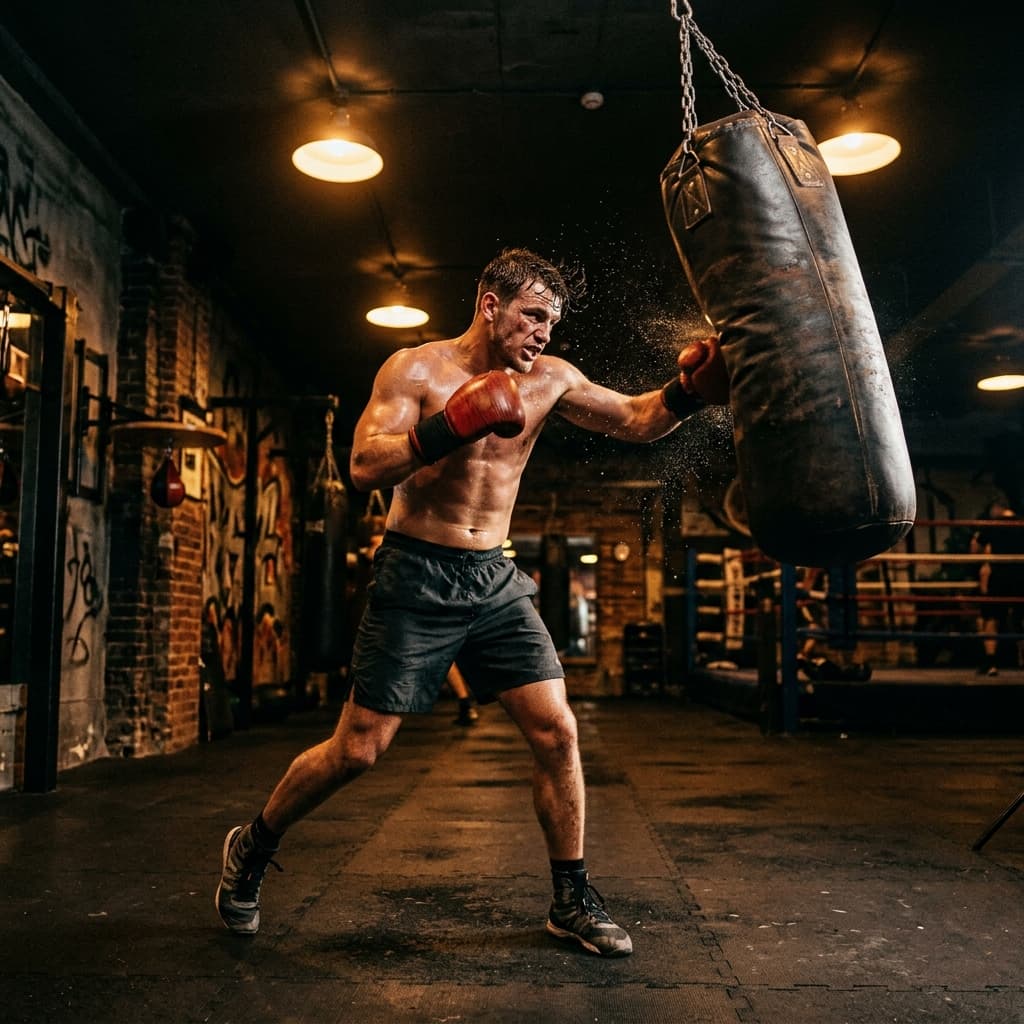
The Workout Structure
This workout runs 6 rounds — 3 minutes each with 1 minute of rest between rounds. Total training time: 23 minutes with rest, or 18 minutes of active work. Each round has a specific focus that progresses from technical warm-up to all-out effort, mirroring how a real fight escalates in intensity.
You will need: a heavy bag (70-100 pounds is ideal), hand wraps, bag gloves or 16oz training gloves, and a round timer. The BoxingWiki timer works great, or any app that lets you set 3-minute rounds with 1-minute rest.
This structure is modeled after how trainers like Freddie Roach and Robert Garcia build their fighters' bag sessions — each round has a purpose. Random punching builds random conditioning. Structured rounds build fight-ready fitness. Before you start, wrap your hands properly, warm up your shoulders with arm circles, and throw 20-30 light jabs at the air to get your range dialed in.
Round 1: Warm-Up Jabs
Three minutes of single jabs and double jabs. Light power, high volume. Aim for 80-100 jabs across the round.
Focus on form — full extension with the lead arm, shoulder raised to protect the chin, and snap the hand back along the same line it traveled out. Every jab should land with a satisfying pop on the bag surface, not a push. The difference is in the retraction speed: a good jab comes back as fast as it goes out. Larry Holmes, who had arguably the best jab in heavyweight history, described it as "touching a hot stove."
Move around the bag using lateral footwork between punches. Step to your left, throw two jabs. Step to your right, throw one. Circle the bag completely during the round. This builds the habit of punching from angles rather than standing directly in front of your target.
Common mistake: fighters start too hard in round 1 and burn their shoulders out before the power rounds. Keep this round at 40-50% intensity. Your deltoids should feel warm and engaged, not fatigued. Think of this round as oiling the machine — getting blood flowing to the shoulders, loosening the hips, and locking in your range on the bag.
Round 2: 1-2 Combinations
Jab-cross combinations at about 70% power. Throw the 1-2, move laterally, reset your stance, throw again. Aim for 30-40 clean combinations across the three minutes.
Focus on the kinetic chain connecting the two punches — the jab extends and snaps back, and the retraction of the jab hand loads the rotation for the cross. Your rear hip should drive forward as the cross fires, transferring power from the ground through your legs, hips, and core into the fist. This is where real punching power comes from — not arm strength. Manny Pacquiao weighed 147 pounds and hit harder than many heavyweights because his hip rotation and timing were flawless.
Between combinations, stay active with footwork around the bag. Do not stand flat-footed admiring your punches. Throw the 1-2, take two steps to the side, reset, and throw again from a new angle. This simulates the movement pattern of a real fight where you are never stationary.
Common mistake: loading the cross so hard that your head lunges forward past your lead knee. This throws your balance off and leaves you vulnerable to a counter. Keep your head centered between your feet even when sitting down on the cross.
Round 3: Power Round
Full-power combinations. This is the round where you sit down on every single punch and commit 100% force. The primary combinations: jab-cross-hook (1-2-3), jab-cross-hook-cross (1-2-3-2), and body shot variations like jab-body cross-lead hook (1-2b-3).
Sit down on every punch — meaning bend your knees slightly and drive upward through the shot. When Thomas Hearns threw his right hand, he would plant his rear foot, drop his level by two inches, and explode upward through the target. That subtle level change is what separates arm punches from punches that move a 100-pound heavy bag.
This round should be exhausting — that is the point. Your heart rate should climb above 85% of your maximum. Your forearms should burn from gripping the fist tight on impact. Your shoulders should feel heavy by the 90-second mark.
When you feel the urge to rest, throw one more combination before resetting. This builds fight-specific mental toughness — the ability to throw one more combination when everything in your body says stop. In a real fight, the fighter who throws last in an exchange usually wins the round on the scorecards.
Round 4: Body Attack
Every punch goes to the body of the bag. Body jabs to the midsection, body hooks to the liver and spleen area, body crosses driven downward at a 45-degree angle. Target the area of the bag that would correspond to the floating ribs and solar plexus on a real opponent.
Bend your knees to change levels — do not bend at the waist. This is critical and one of the most common mistakes on the heavy bag. Bending at the waist pulls your head forward into punching range and removes your legs from the kinetic chain. Instead, sit into a slight squat and punch from that lowered base. Your thighs will burn. That is the point — this round builds the leg endurance needed to go to the body effectively.
Julio Cesar Chavez was a master body puncher who would systematically break down opponents by going to the body in the middle rounds. His technique was built on relentless level changes — dropping his stance and digging hooks to the liver. Emulate that approach: throw a jab to the head of the bag, then drop your level and dig a left hook to the body. Alternate between head and body height to practice the level changes.
This round conditions you to fight at different heights, which is essential because most beginners only throw at head level. A fighter who attacks the body forces their opponent to lower their guard, opening up head shots later in the fight.
Round 5: Speed Round
Maximum volume, moderate power. The goal is simple: throw as many clean punches as you can in three minutes. Aim for 150+ punches across the round. Keep power at about 50-60% — enough to snap the bag but not so much that you sacrifice speed for force.
Keep the combinations short — 1-2, 1-1-2, 1-2-1 — thrown at high speed with quick one-second resets between bursts. Think of Manny Pacquiao's combination style: rapid-fire clusters of four to six punches followed by an angular step, then another burst. Volume overwhelms defense.
This round targets the fast-twitch muscle fibers and trains your neuromuscular system to fire rapidly under fatigue. By round 5, your shoulders are heavy and your lungs are working hard. That is exactly the state you need to train speed in — because in a fight, you will never throw fast combinations when you are fresh. You need to be fast when you are tired.
Common mistake: sacrificing form for speed. Every punch should still travel in a straight line (for jabs and crosses) or a tight arc (for hooks). If your punches start looping wide because you are rushing, slow down slightly and tighten the mechanics. Sloppy speed is just sloppy.
Round 6: Championship Round
Everything you have left. This round is named after the final round of a championship fight — the round where the outcome is decided and both fighters dig deeper than they thought possible.
Alternate between 30-second bursts of all-out combination work and 30-second periods of active footwork and single jabs. That gives you six burst sets across the three minutes. During the burst phases, throw your hardest, fastest combinations — 1-2-3-2, body-head-body, anything you have. During the recovery phases, keep moving laterally around the bag and popping single jabs to maintain rhythm. Do not stop moving during recovery. Standing still teaches your body it is acceptable to shut down, and in a fight that gets you hurt.
This round simulates the championship rounds (rounds 10-12) that separate contenders from champions. When Marvin Hagler fought Thomas Hearns in their legendary 1985 fight, both fighters threw everything they had in a brutal first round because neither wanted to leave it to the judges. That level of controlled desperation is what you are training here.
By the end of this round, your arms should feel heavy, your lungs should burn, and your shirt should be soaked. This is where mental toughness is built. The physical adaptations matter — improved lactate clearance, increased stroke volume, enhanced fast-twitch endurance — but the mental adaptation is equally important. You are teaching yourself that you can perform when your body is screaming to stop. That lesson transfers directly to the ring.
After the final bell, cool down with two minutes of light shadow boxing and stretching. Do not collapse on the floor — stay moving to help your heart rate come down gradually and prevent blood pooling in your legs.
See these techniques broken down by featured creator Coach Josh.
Access the full heavy bag training program
The Boxing Blueprint is a 4-part video course covering fundamentals, conditioning, footwork, and fight strategy.
View The Boxing BlueprintReady to Practice?
Put what you learned into action with a guided shadowboxing session or timed heavy bag workout.