Why the First 30 Days Matter More Than Any Other
Every world champion started exactly where you are now — standing in a gym, unsure where to put their hands. Mike Tyson was a pudgy, bullied kid from Brownsville when Cus D'Amato first showed him how to stand. Manny Pacquiao was a rail-thin teenager fighting in parking lots in General Santos City. The gap between them and you on day one? Basically nothing.
The first 30 days of boxing determine whether you build real habits or accumulate bad ones. Your nervous system is forming movement patterns right now that will either serve you for years or need to be painfully unlearned later. That's why this guide exists — to give you a structured, no-nonsense roadmap through the critical first month.
Don't worry about speed. Don't worry about power. Your only job for 30 days is to move correctly, slowly, over and over, until the movements stop feeling foreign. That's how every great fighter started. That's how you'll start too.
Before You Begin: Gear and Mindset
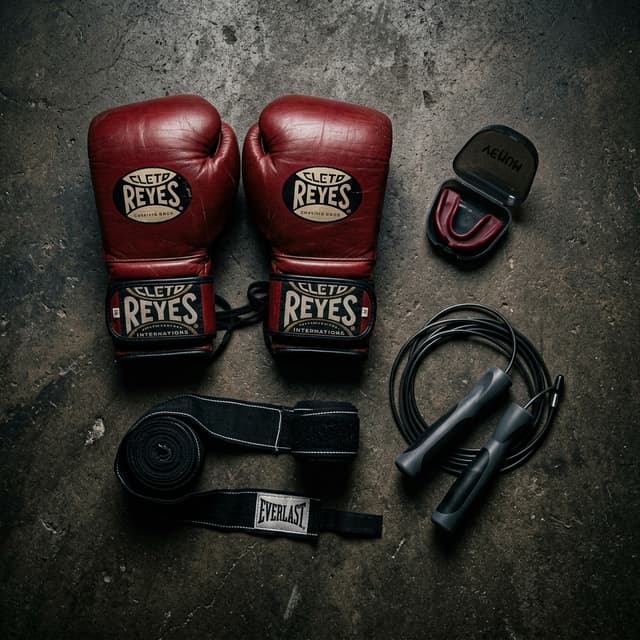
You don't need much to start. Hand wraps, a pair of boxing gloves (14-16 oz for training), and comfortable athletic shoes are the essentials. Skip the bag gloves for now — you're not ready for the heavy bag yet, and that's fine.
Wrap your hands every single session. No exceptions. Your hands have 27 small bones each and zero natural padding over the knuckles. Wraps protect the small joints and stabilize your wrist so you can actually practice punching without fear of injury.
Mindset check: You will feel uncoordinated. You will forget which foot goes where. You will throw a jab and realize your other hand dropped. This is normal. Boxing asks your body to do things it has never done — move in a bladed stance, rotate from the hips, keep your chin tucked while your hands work independently. Give yourself permission to be bad at this for a while.
180-inch hand wraps (Mexican-style stretch preferred)
14-16 oz boxing gloves for all bag and partner work
Flat-soled shoes or wrestling shoes — no running sneakers
A timer app with round/rest intervals (3-minute rounds, 1-minute rest)
A full-length mirror if training at home
Week 1: Stance, Guard, and Movement
This week you throw zero punches. That might sound absurd, but the stance is your foundation. Every punch, every defensive move, every angle you'll ever create starts and ends in your stance. Get it wrong and everything built on top of it will be crooked.
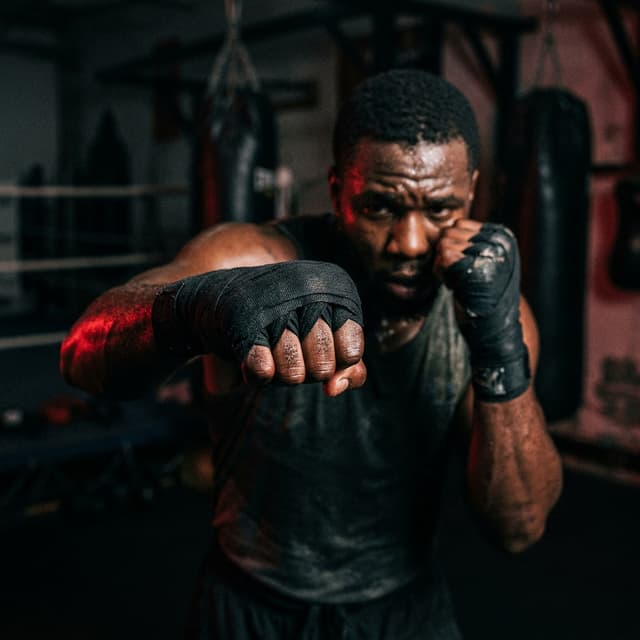
The orthodox stance (for right-handers): left foot forward, right foot back, feet roughly shoulder-width apart. Weight distributed about 60/40 on the back foot. Knees slightly bent. Hands up — left hand at eyebrow height, right hand glued to your cheek. Elbows tucked tight to your ribs. Chin down, eyes forward.
Spend 10-15 minutes per day just standing in your stance and checking yourself in a mirror. Then start moving. Step-drag footwork is your first movement pattern — push off the back foot to go forward, push off the front foot to go backward. Never cross your feet. Never let your feet come together. The stance stays the same width no matter where you go.
Daily practice structure for Week 1:
Do 3 rounds of shadow boxing with zero punches. Just move. Forward, backward, left, right. Circle left, circle right. Get comfortable existing in your stance while your legs burn. By the end of the week, the stance should feel less like a foreign language and more like an accent you're starting to pick up.
Round 1: Stance check in mirror — feet, hands, chin, elbows. Hold for 3 minutes.
Round 2: Step-drag forward and backward across the room. Stay in stance.
Round 3: Lateral movement — slide left 4 steps, slide right 4 steps. Repeat.
Cooldown: 2 minutes of relaxed bouncing in stance, staying loose
Week 2: The Jab and the Cross
Now you get to hit something — the air. Shadow boxing is where you learn punches, not the heavy bag. The bag teaches bad habits to beginners because it doesn't move, it doesn't punish you for dropping your guard, and it rewards arm-punching with a satisfying thud.
The jab is your most important punch. It sets up everything. Extend your lead hand straight from your chin, rotate your fist so the palm faces down at full extension, and snap it back to your face. The power comes from a small push off your front foot and a slight rotation of your lead shoulder. Your rear hand stays glued to your cheek the entire time.
Once your jab feels natural — typically by mid-week — add the cross. This is your power hand. Rotate your rear hip and shoulder forward, driving the punch straight from your chin. Your rear heel pivots off the ground. The cross travels in a straight line, not a loop. Think of your shoulder replacing your chin as you rotate.
The one-two combination — jab followed immediately by the cross — is the most fundamental combination in boxing. Vasyl Lomachenko throws it. Canelo Álvarez throws it. Every amateur in every gym on every continent throws it. Practice it until it's a single fluid motion, not two separate punches.
Daily practice structure for Week 2:
Round 1: Footwork warmup from Week 1 — move in all directions
Round 2: Jab only. Throw 50 jabs. Focus on full extension and hand return.
Round 3: Cross only. Throw 50 crosses. Focus on hip rotation and keeping the lead hand up.
Round 4: One-two combinations. Throw 30 combos. Reset stance after each one.
Round 5: Shadow box freely using only jab and cross with movement. Visualize an opponent.
Cooldown: 1 round of light bouncing and single jabs
Week 3: Hooks, Basic Defense, and Ring Awareness
Week 3 introduces the punch that finishes fights and the defensive skills that keep you from getting finished. The lead hook is a short, compact punch thrown in an arc. Your elbow lifts to shoulder height, your fist stays vertical or horizontal (both work — find what's natural), and the power comes entirely from rotating your hips and pivoting on your lead foot. Common mistake: winding up by pulling the hand back first. Don't. The hook starts and ends from your guard position.
Now, defense. The high guard is your default — hands up, elbows tight, chin tucked behind your gloves. From here, you can catch punches on your gloves, block hooks with your forearms, and keep your head behind a wall of leather.
Introduce slipping this week. A slip is a small lateral bend at the waist to let a punch pass over your shoulder. Slip outside (to your left against an orthodox jab) by bending your knees and shifting your weight to your lead leg. Slip inside by shifting to the rear leg. The movement is tiny — 4-6 inches maximum. You're not ducking under a limbo bar. You're making a straight punch miss by the width of your head.
Daily practice structure for Week 3:
Round 1: Footwork warmup with direction changes every 10 seconds
Round 2: Lead hooks only. Throw 40 hooks. Check elbow height and hip rotation.
Round 3: Jab-cross-hook combinations. Throw 25 combos. Hands return to guard between punches.
Round 4: Defense round — practice slipping left and right in the mirror. No punches.
Round 5: Shadow box with all punches and slips. Imagine an opponent jabbing at you.
Round 6: Free shadow boxing round — use everything. Move, punch, slip, reset.
Week 4: Combinations, Footwork Integration, and Putting It All Together
This is where it starts to feel like boxing. You have the tools now — stance, jab, cross, hook, footwork, guard, and slips. Week 4 is about connecting them into fluid sequences.
Start combining offense and defense. Throw a jab-cross, then immediately slip to your right as if your opponent is countering. Throw a one-two-hook, then step-drag backward out of range. The punch-and-move rhythm is what separates a boxer from someone who just throws punches.
Introduce the pivot this week. After throwing a combination, pivot on your lead foot to change the angle. This is how you avoid being a stationary target. Sugar Ray Leonard was a master of this — fire a combination, pivot 45 degrees off the center line, and suddenly your opponent is punching at where you were, not where you are.
Build 3-4 go-to combinations and drill them obsessively:
Jab — Cross — Step back (basic range management)
Jab — Cross — Lead hook — Pivot right (angle change after offense)
Double jab — Cross — Slip outside — Cross (counter after defense)
Jab — Lead hook to the body — Lead hook to the head (level change)
Common Frustrations and How to Push Through
"I keep dropping my hands." Everyone does. Your shoulders aren't conditioned yet to hold your hands at chin height for extended periods. This fixes itself with time. Do 30-second guard holds between rounds — just stand in your stance with your hands up and elbows tight. The burn is the fix.
"My punches feel weak." They should. You're not trying to generate power yet. You're building the motor pattern — the correct sequence of hip rotation, shoulder turn, and arm extension. Power comes from technique, not effort. Juan Manuel Márquez didn't knock out Manny Pacquiao with a lucky punch — he threw it with perfect timing and perfect mechanics. The mechanics come first. The power follows.
"I feel stupid shadow boxing." Floyd Mayweather Jr., the highest-paid athlete in boxing history and owner of a 50-0 record, shadow boxed religiously for his entire career. If it's good enough for him, it's good enough for you. Shadow boxing is where you think through your boxing. It's where you build the habits that show up under pressure.
"I'm not getting better fast enough." You're comparing your day 14 to someone else's year 3. Stop. The fighters who make it aren't the most talented — they're the ones who showed up on day 15, and day 45, and day 200. Consistency beats intensity every single time. Thirty minutes of focused practice five days a week will make you a better boxer than two marathon sessions followed by a week off.
After 30 days, you'll have a solid stance, a functional jab and cross, a developing hook, basic defensive instincts, and the footwork to move without tripping over yourself. You won't be a boxer yet. But you'll have the foundation to become one. That's what the first 30 days are for.
What Comes Next
After your first month, you're ready for real gym training. Find a boxing gym with a coach — not a cardio kickboxing studio, not a boutique fitness class. A real gym where people spar, where a coach watches your form and corrects you in real time.
Start working the heavy bag with supervision. Begin partner drills — mitt work with a coach is one of the fastest ways to improve timing and accuracy. And when your coach says you're ready — and only when your coach says you're ready — you'll start light sparring.
The first 30 days built the vocabulary. Now you start learning how to speak the language.
See these techniques broken down by featured creator Coach Josh.
Start the BoxingWiki Fundamentals Course
The Boxing Blueprint is a 4-part video course covering fundamentals, conditioning, footwork, and fight strategy.
View The Boxing BlueprintReady to Practice?
Put what you learned into action with a guided shadowboxing session or timed heavy bag workout.