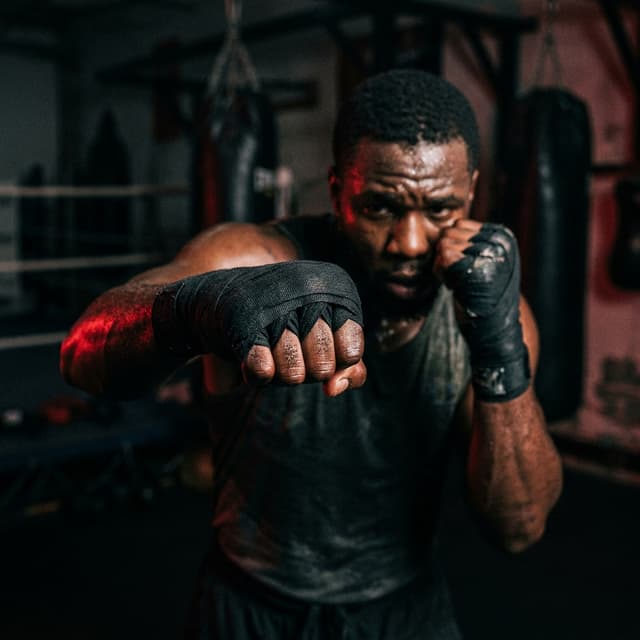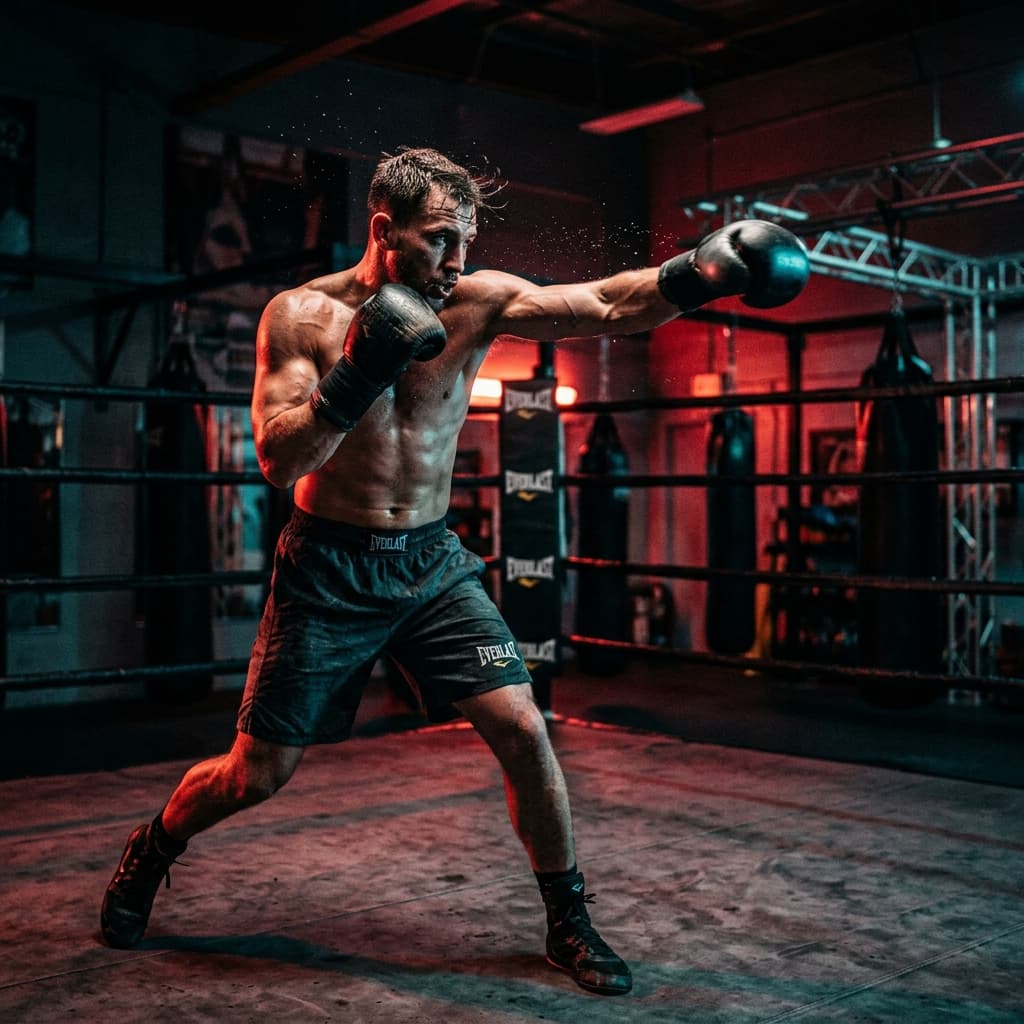
The hook is the punch that breaks open fights. The jab measures distance. The cross scores points. The hook ends it.
I have a 16-year-old student named Marcus who could throw a jab like Sugar Ray. Lightning fast, perfectly timed, always on. But his lead hook? Weak. He pulled it back like he was winding up a baseball swing, opened his elbow to a 135-degree angle, and telegraphed it from half the gym. He was getting countered every time he tried it.
After six weeks of breaking the habit and rebuilding from the hips, the hook became Marcus's go-to punch. Not because he got stronger. Because he finally understood where the power comes from.
This is how you throw one.
What is a Hook Punch?
A hook is a short-range punch thrown in a lateral arc. It generates power from rapid hip and core rotation, not from the arm. Your lead foot plants, your hips snap forward, and your forearm comes across your body in a tight circle.
The punch has three main variants: the lead hook, the rear hook, and the body hook. They share the same basic mechanics but differ in setup, range, and target.
Think of it as a punch that travels horizontally. Not up like an uppercut. Not straight like a cross. Horizontally. Your fist stays roughly at the same height from start to finish, and the power comes from your whole body rotating behind it.
See the hook technique breakdown on BoxingWiki for detailed anatomy and muscle engagement.
The Lead Hook
Your first punch in count notation. For an orthodox fighter, this is the left hook.
Your lead hand is already close to the opponent. The distance is short. That means the lead hook is fast and hard to see coming, if you throw it right. It lands at close to mid range and is widely considered the most dangerous knockout punch in boxing.
Why? Because the power path is short. Your lead leg is loaded, your hips are already turned slightly toward the opponent, and you just need to snap everything forward. Jack Dempsey called the looping punches "the whiskey punches" because they went around the guard. The lead hook is the best whiskey punch in your arsenal.
The Rear Hook
The number two for your back hand. Less common, but devastating when it lands.
The rear hook needs more rotation than the lead hook. You have to square up slightly more, pivot harder on the rear foot, and drive through both legs. It works best after slipping inside an opponent's jab, or as a follow-up to a lead hook when they cover up.
Muhammad Ali loved the rear hook. It was his setup-to-cross finisher, but he also threw it as a surprise shot when opponents thought he only had straight punches.
The Body Hook
Same arm mechanics, different level. You drop your hips, tighten the arc, and drive into the ribs or liver.
The liver shot is on the opponent's right side. A lead body hook to that spot can end a fight at any level. I am not exaggerating. I have seen heavyweight amateurs in shape folded in two from a 140-pound guy hitting their liver with a properly thrown hook.
Step-by-Step: How to Throw a Hook
The Lead Hook
Start in your boxing stance. Weight slightly on the lead leg.
Your lead elbow is at roughly 90 degrees. Not wider. I see this mistake constantly. People open their elbow and try to reach with a semi-extended arm. That is not a hook. That is just an arm swinging at someone.
Pivot hard on the ball of your lead foot. Your heel should lift off the ground.
Rotate your hips. Your lead hip shoots toward the opponent. This is not a small movement. Your whole core snaps forward.
The arm follows the hips. Do not think about throwing a punch. Think about turning your body so fast that your arm has no choice but to come across. Visualize your forearm as a solid block moving laterally.
When the punch crosses your centerline, stop. Do not follow through the other side. Retract. Your fist should not travel past your nose.
Keep your rear hand glued to your chin. Always.
The Rear Hook
Shift your weight to your rear leg and drop slightly. The power starts from a coiled position.
Pivot hard on the ball of your rear foot. This is more aggressive than the lead hook because your whole body needs to rotate.
Rotate your hips and torso. Your shoulders turn. Your elbow stays at about 90 degrees.
Drive the punch across in a tight arc. Your lead hand is up and back, protecting against counters. The rear hook is dangerous to yourself if you leave your head exposed.
Return to your stance immediately. Do not hang on the punch.
The Body Hook
Drop your level. Bend your knees and lower your hips. Do not just bend at the waist. That telegraphs and loses balance.
Keep your elbow tight to your body at 90 degrees. The arc is even smaller than a head hook.
Rotate your lead hip and pivot your lead foot, same as the head hook.
Drive the hook into the ribcage or liver area. For a lead body hook, aim at the opponent's right side to hit the liver.
Reset your level right away. Standing bent over is how you get punched in the head.
Common Mistakes
Winding up. Pulling the hand back before throwing the punch. This is the number one error I see in my gym. The hook should start from your guard. No backward movement. No pull. Just rotation and forward drive. The hand leaves your chin and travels across. If you can see your fist move away from you before it moves toward the target, you are winding up.
Opening the elbow. A 90-degree bend is the sweet spot. Go wider and you lose power. Go narrower and you lose range. I tell students to imagine holding a coffee mug by their ear. That is roughly the angle you want.
Throwing with just the arm. No rotation. No foot pivot. Just a swinging arm. This generates maybe 20% of the hook's potential power. Watch the pros. Their shoulders turn. Their hips fire. Their feet move. The arm is just the end of the chain.
Following through the other side. Letting the hook travel past your centerline leaves you open for a counter cross. The punch should stop almost in front of your face and retract instantly.
Squaring up for the rear hook. You need some rotation, yes, but if you turn your entire torso toward the opponent, you have walked into a cross. The hip turns, the foot pivots, but your lead shoulder stays in front of you.
Forgetting to protect the head when going to the body. A dropped rear hand is an invitation. Keep it up.
How to Practice
Shadow Boxing Drills
Start slow. In front of a mirror. Throw single lead hooks and watch your mechanics.
Does your elbow open up? Watch it. Does your heel stay on the ground? Check. Is your rear hand dropping? Look for it.
Work these progressions:
- Single lead hooks, 30 seconds. Focus on form only.
- Single rear hooks, 30 seconds. Watch your balance.
- Lead hook to body, lead hook to head. Alternate levels, 30 seconds.
- Two-round shadow boxing session. Throw hooks only. Everything else is a jab or a foot movement.
Heavy Bag Work
The bag teaches you how a hook feels on impact. Set up differently than for jabs and crosses.
Stand closer. Close enough that you can feel the bag against your chest without actually leaning into it.
- 10 single power hooks. Throw each one at full effort, then reset your stance completely before the next one.
- 30-second rounds of alternating lead and rear hooks. Keep the rhythm moving.
- Body hook rounds. Drop your level and throw tight hooks into the bag's lower section. Aim for the "liver zone" on the bag's right side if you are orthodox.
Mirror and Slow Motion
Once a week, do 5 minutes of mirror work at 30% speed. This is tedious. Most boxers skip it. You should not.
Slow motion exposes every flaw. You will see your hand drop. You will notice your elbow flies open. You will catch yourself pulling back. Fix these issues at slow speed and they disappear at fight speed.
Partner Drills
Have a training partner hold focus mitts at hook range, close, within your lead fist's natural arc.
- Single lead hook combinations. Your partner calls out "hook" and holds the pad.
- Hook to body, hook to head sequences. Changes your level under pressure.
- Slip inside, throw a rear hook. This is the most valuable drill because it trains the hook in a realistic fight scenario.
Pro Tips
The hook is a setup weapon. I have students who think they need power to land a hook. Wrong. You need power to finish with a hook. Setting up other shots is how the hook earns its keep. Throw a short, quick hook to make your opponent cover up, and the cross writes checks the rest of the combination can cash.
Thumb position matters. For the lead hook, keep your thumb pointing up like you are holding a "coffee mug" at head height. As you drop to the body, your thumb can gradually turn toward you. Do not let it flip outward. A broken thumb from a bad hook is a real thing.
Combine it with footwork. Step in with the hook. Pivot on the hook. Change angles with the hook. A stationary hook is a predictable hook. The best hook throwers I have trained use a step, a pivot, or a weave to get into position, then fire the punch from a new angle.
Use the hook against the cross. When an opponent fires a cross, their arm is extended to their left side. Their right side is open. A lead hook at that moment lands on exposed terrain. See the slip outside technique on BoxingWiki for how to move into this counter position.
Breathe out on impact. Short sharp exhale through clenched teeth. "Tss" or "shh." The exhale engages your abs, tightens your core, and transfers more power from hips to fist.
Practice the rear hook to the body specifically. This is an undervalued weapon. The rear body hook targets the ribs on the opponent's left side and catches them when they lean away from a head shot. Manny Pacquiao used this ruthlessly. Throw the jab, make them raise their hands, and bury a rear hook under and around their guard. It is a fight shortener.
Related Techniques
- The cross (straight rear hand) sets up the lead hook through natural body rotation.
- Lead uppercut from inside range, thrown from the same position.
- The body hook is the hook applied to torso targets.
- The slip inside defensive move creates the position for a rear hook counter.
Quick Summary
- Hook power comes from hip rotation and a planted pivot foot, not from swinging the arm.
- Keep your elbow at 90 degrees. Do not open it wider.
- The punch travels horizontally. Stop at your centerline. Retract immediately.
- Always keep your opposite hand at your chin.
- Set up the body hook with a head shot first.
- Practice single hooks at slow speed in front of a mirror before adding pressure on the bag.
- The rear hook is underrated. Train it.
The hook is harder to learn than the jab or cross. I do not sugarcoat that. It demands coordination between your lower body, your core, and your arm that takes time to wire in. Give it the reps. Most boxers will be throwing decent hooks within three to four months of focused practice. After that, it becomes the punch that defines your offense.
See these techniques broken down by featured creator Coach Josh.
Ready to Practice?
Put what you learned into action with a guided shadowboxing session or timed heavy bag workout.