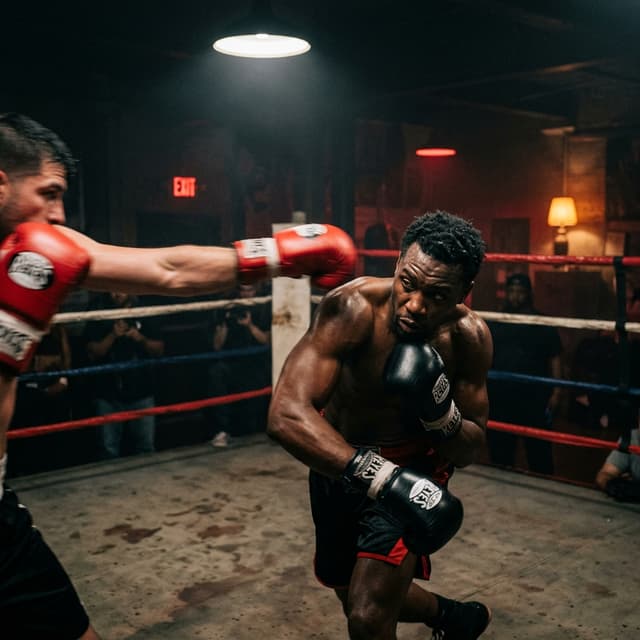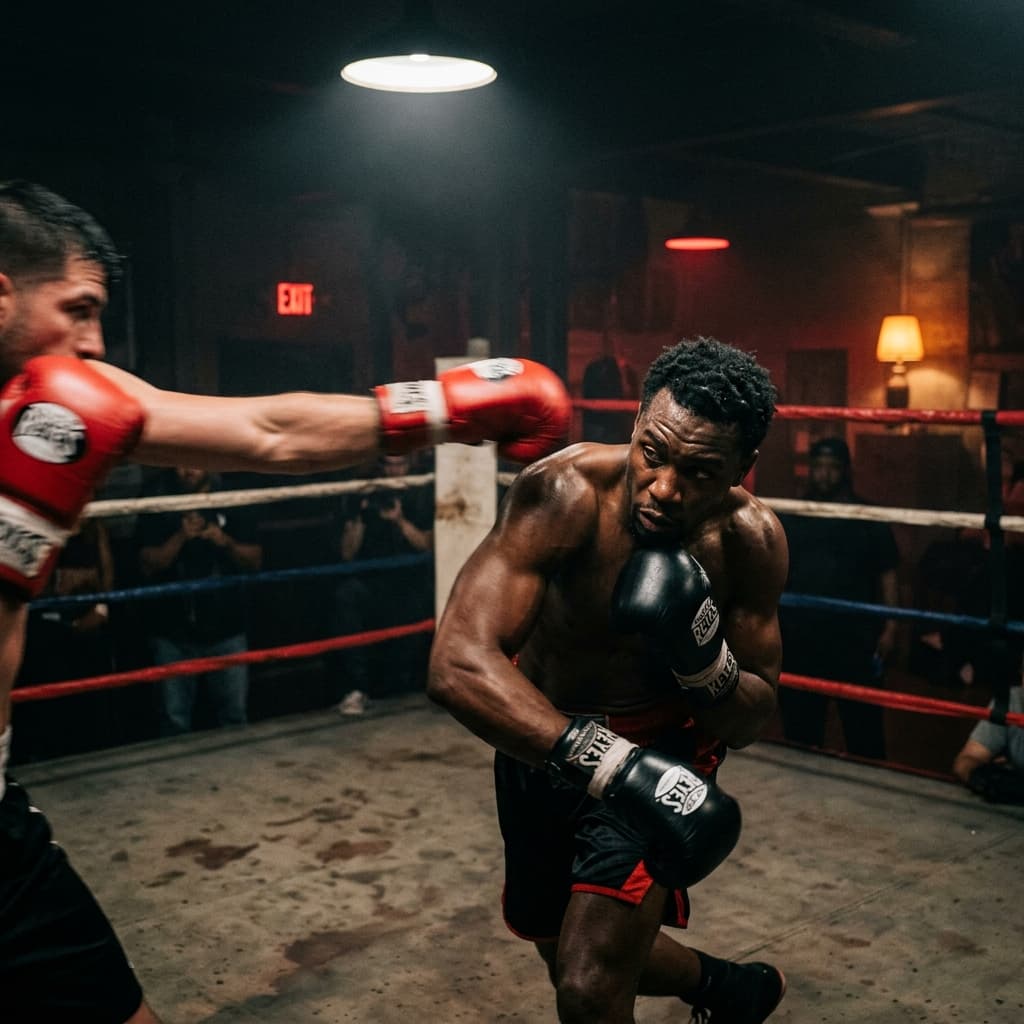
The Difference Between Slipping and Rolling
Both movements take your head off the center line to avoid punches. But they work on different planes and set up different counters, and confusing them under pressure is one of the fastest ways to get hurt.
A slip moves your head laterally — left or right — to dodge straight punches like the jab and cross. The movement is primarily a rotation of the torso around the spine, with a slight lateral shift of weight. Biomechanically, your spine acts as a vertical axis, and your shoulders rotate around it, moving your head just enough for the punch to sail past your ear. Pernell Whitaker was the master of the slip — his head would move two inches and punches would miss by fractions, leaving him perfectly positioned to counter.
A roll (also called a bob and weave) moves your head in a U-shaped arc under wide punches like hooks. The movement comes primarily from bending the knees and shifting the weight in a downward-and-lateral motion. Your head traces a path that goes down, across, and back up — like drawing a U in the air with your chin. Mike Tyson's bob and weave was so fast and deep that opponents would throw hooks that hit nothing but air, and he would come up on the other side already throwing.
Knowing which to use and when is the difference between eating a clean shot and making your opponent miss by inches. Use the wrong defense for the wrong punch — slip a hook, for example — and you move your head directly into the arc of the incoming shot.
The Slip
Slipping is a small, subtle movement. You bend slightly at the waist and shift your weight just enough for the punch to pass by your ear. The critical biomechanical principle here is minimal displacement for maximum effect. You are not trying to move your head a foot to the side. You are trying to move it two to four inches — just enough that the opponent's fist grazes air instead of your chin.
The key word is "just enough." A two-inch slip is just as effective as a twelve-inch lean — and it keeps you in range to counter immediately. This is why slipping is considered a more offensive defense than blocking. When you block, you absorb force and stay in the same position. When you slip, you avoid force entirely and end up at an angle where you can fire back while your opponent is extended and off-balance.
Canelo Alvarez demonstrates this perfectly. Against Gennady Golovkin in their second fight, he slipped Golovkin's jab by rotating his torso just enough to let the punch pass, then fired a counter right hand that Golovkin never saw coming. The slip was so small it barely looked like he moved — but it created a clean counter opportunity from a position of safety.
There are two primary slip directions, and each sets up different counters:
To slip outside a jab: shift your weight to your rear foot and rotate your torso slightly, letting the jab pass over your lead shoulder. This positions you outside the opponent's power hand, which is the safest place to be. From here, you can counter with a straight right (orthodox) or a lead hook to the exposed body.
To slip inside a jab: shift your weight to your lead foot, letting the jab pass over your rear shoulder. This is riskier because you are now in line with the opponent's rear hand, but it sets up devastating counters — a lead hook to the chin or an uppercut through the gap between their arms.
Keep your eyes on the opponent at all times — never look at the floor. The moment you drop your eyes, you lose sight of the follow-up punch. Your vision should stay fixed on the opponent's chest or chin, using peripheral vision to track their hands.
Your hands stay up throughout the slip. This is a head movement, not a hand movement. A common beginner error is reaching the hands outward during a slip, which opens the guard entirely. The hands remain in their guard position — the head moves, the hands do not.
The Roll (Bob and Weave)
Rolling is your answer to hooks and wider punches. Where the slip handles linear attacks, the roll handles circular ones.
You bend your knees to drop your level, let the punch sail over your head, and come up on the other side. The motion traces a U-shape — down, across, and up. The biomechanics here are crucial: the entire movement should be driven by the legs, not the back. Bending at the waist to duck a hook is one of the most dangerous mistakes in boxing because it drops your head to exactly the height where uppercuts live. Bending at the knees keeps your torso upright, your back straight, and your head at a level where the hook passes harmlessly overhead.
When you come up on the other side, you are in a loaded position — your legs have stored elastic energy from the bending motion, and your weight is shifted to the side you came up on. This means you can immediately fire a counter hook or uppercut with significant power generated from the legs. This is the sequence that made Joe Frazier terrifying: he would weave under a right hand and come up with a left hook that had the force of his entire body rising behind it. His knockdown of Muhammad Ali in the fifteenth round of their first fight was exactly this — weave under, come up, hook.
Mike Tyson refined this to an art form under Cus D'Amato. His peek-a-boo style was built around constant bobbing and weaving, making him nearly impossible to hit cleanly with wide shots. He would weave under a hook, come up on the opposite side, and throw a devastating combination from an angle his opponent was not expecting. The roll was the engine that made his entire offense work.
Bend at the knees, not the waist — bending at the waist puts your head right at uppercut height. Keep your back relatively straight and lower your level through your legs, like a shallow squat.
Dip under the incoming hook, moving your head in a smooth arc. The arc should be continuous — do not pause at the bottom. Think of it as one fluid motion, not three separate steps.
Come up on the other side with your weight loaded for a counter hook or uppercut. Your legs should straighten as you rise, driving force upward through your body and into your punch.
Keep your hands up and elbows tight throughout the entire motion. Many fighters drop their hands during the weave because they are focused on moving their head — this leaves them vulnerable to a second hook or an uppercut on the way up.
When to Slip, When to Roll
The rule is simple: slip straight punches, roll hooks.
When you see a jab or cross coming, slip. The straight punch travels in a line, so moving laterally takes you off that line. When you see a hook, roll under it. The hook travels in an arc, so moving laterally keeps you on that arc — you have to go under it.
If you try to slip a hook, you move your head sideways into the path of the swinging arm. That is how people get knocked out by punches they were "defending." Conversely, if you try to roll under a jab, you drop your head right into an uppercut trap.
In practice, the two movements flow together naturally. A skilled opponent will throw combinations that mix straight and circular punches precisely to test whether you know the difference. You might slip a jab, then immediately roll under the follow-up hook — this is the classic slip-roll defensive sequence that coaches drill endlessly. Juan Manuel Marquez was exceptional at chaining these movements together, slipping jabs and rolling hooks in continuous sequences that left his opponents punching air while he found counter opportunities.
Training both until they become reflexive is the goal. You do not have time to consciously decide which defensive movement to use when a punch is already in flight. The decision must be automatic — your body reads the angle of the incoming shot and responds with the correct movement before your conscious mind has finished processing what is happening. This is why repetitive drilling matters more than understanding. You need thousands of reps until the correct response is wired into your nervous system.
Drilling Defense
Partner drills are essential here because defensive skills require realistic stimuli — you need to see real punches coming at your head to develop the reflexes that matter in sparring and fighting.
Level 1 — Single jab slipping: Have a partner throw slow, controlled jabs while you practice slipping to both sides. The partner should target your chin at about 30% speed, and you should focus on minimal movement — just enough to make the jab miss. Do two rounds of this, one round slipping outside (to the rear foot side) and one round slipping inside (to the lead foot side).
Level 2 — Hook rolling: The partner throws slow, wide hooks while you practice the bob and weave. Focus on bending the knees, keeping your eyes up, and coming up on the opposite side in a balanced position ready to counter. Start with hooks from one side only, then progress to alternating hooks.
Level 3 — Combination defense: Progress to jab-hook combinations — slip the jab, roll the hook. This is where the two movements begin to flow together. The partner throws a jab immediately followed by a lead hook. You slip the jab laterally and immediately drop into a roll to avoid the hook. This is the bread-and-butter defensive drill used in every serious boxing gym.
Level 4 — Speed progression: Gradually increase the speed over several sessions. The goal is to reach about 70-80% speed while maintaining clean technique. At full sparring speed, your defensive movements will never be as clean as they are in drills, but the foundation built at slower speeds translates directly.
If you train alone, shadow boxing in front of a mirror works too — throw imaginary punches at your reflection and practice slipping and rolling your own shots. The slip bag (a small bag on a cord that swings like a pendulum) is another excellent solo tool. Stand in front of it, push it, and practice slipping and rolling as it swings back and forth. This builds timing and rhythm against a moving stimulus without requiring a partner.
See these techniques broken down by featured creator Coach Josh.
Build your complete defensive toolkit
The Boxing Blueprint is a 4-part video course covering fundamentals, conditioning, footwork, and fight strategy.
View The Boxing BlueprintReady to Practice?
Put what you learned into action with a guided shadowboxing session or timed heavy bag workout.