What Is the Shoulder Roll?
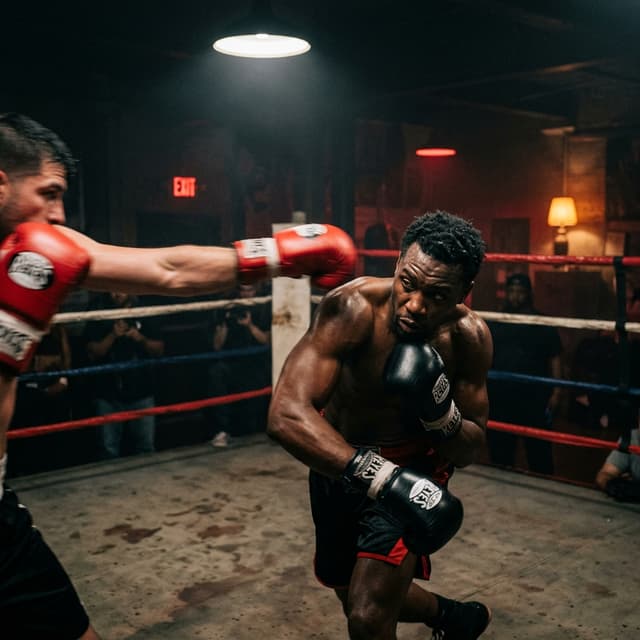
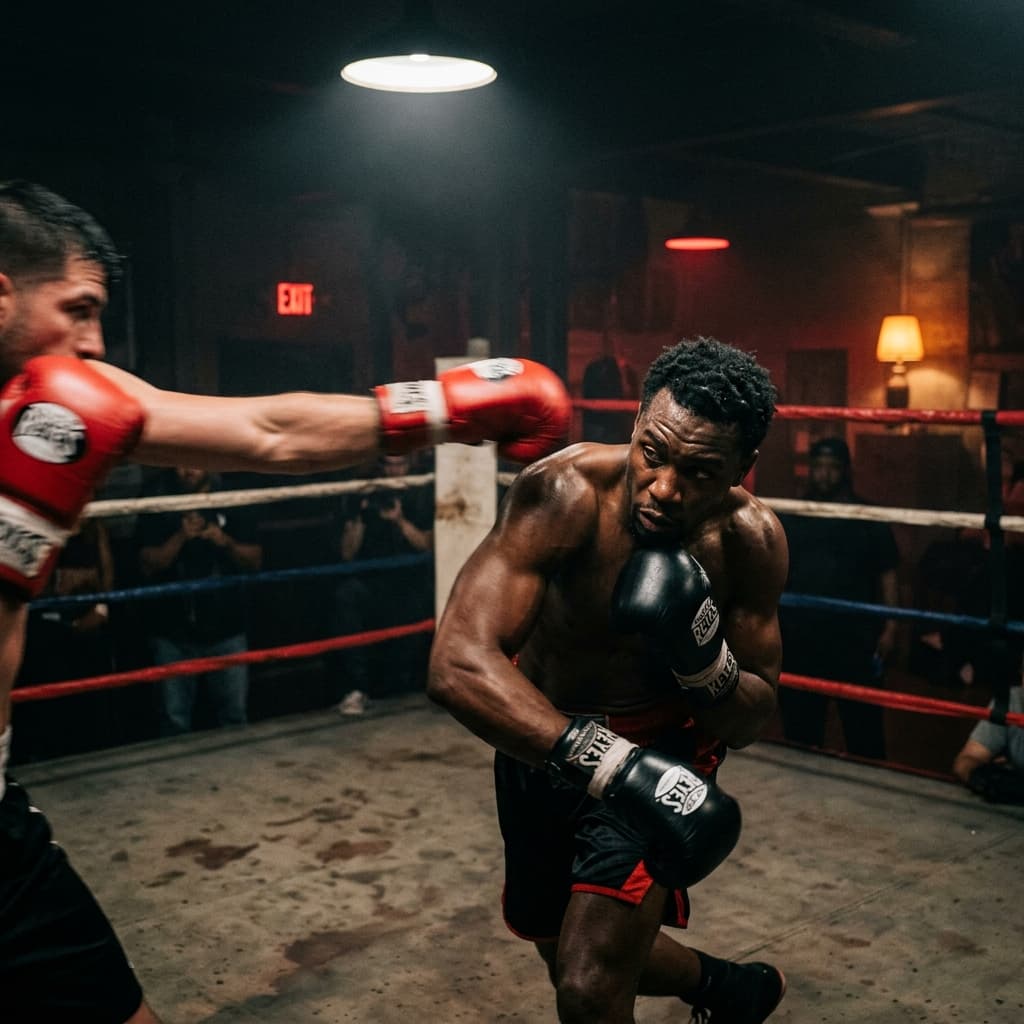
The shoulder roll is a defensive technique where you raise your lead shoulder to deflect incoming punches — particularly the jab and cross. It is one of the most aesthetically beautiful defensive techniques in boxing, and one of the most difficult to execute correctly under pressure.
The lead hand drops to the waist or hip level, positioned across the body to catch body shots with the forearm. The rear hand stays glued to the cheek, acting as the last line of defense. When a straight punch comes in, the lead shoulder rotates upward and forward to meet it. The rounded surface of the deltoid muscle deflects the punch — the force slides off rather than being absorbed — and the fighter fires back immediately with the rear hand, which is already loaded from the weight shift to the back foot.
Floyd Mayweather Jr. made this famous at the highest level, turning it into the centerpiece of a defensive system that allowed him to retire 50-0. But the technique has roots in the Philadelphia boxing scene going back decades — which is why it is called the Philly Shell. George Benton, a Philadelphia middleweight in the 1960s who later became one of boxing's most respected trainers, is widely credited with refining and teaching the shoulder roll as a systematic defensive approach. He passed it to fighters like Pernell Whitaker, who used it to become virtually unhittable in his prime, and the knowledge eventually reached Mayweather through the training lineage.
James Toney was another master of the shoulder roll, using it at middleweight and super middleweight to frustrate power punchers who could not land clean despite throwing hundreds of shots. Toney's version was more aggressive than Mayweather's — he would roll shots and immediately counter with hooks and uppercuts from unconventional angles.
The Stance and Setup
The Philly Shell uses a more bladed stance than standard boxing position. You turn your lead shoulder further toward the opponent, presenting a smaller target. This bladed position reduces the surface area your opponent can hit with straight punches — instead of seeing your full chest, they see mostly your lead shoulder and arm.
Biomechanically, this stance pre-loads your body for counter punching. With your weight slightly back and your rear hand at your cheek, you are in a coiled position — like a spring compressed and ready to release. The counter cross from this position travels a short distance but carries significant force because it has the full weight shift and hip rotation behind it.
The stance also changes your distance calculation. Because you are more bladed, your lead shoulder is actually closer to the opponent than it would be in a standard stance, which means their jab has to travel a shorter distance to reach you. This is counterintuitive — you would think a defensive stance would create more distance — but the Philly Shell compensates by using the shoulder as a shield rather than relying on distance for safety.
Stand more bladed than your normal stance — lead shoulder turned toward the opponent. Your torso should be rotated roughly 60-70 degrees from square, compared to the standard 30-45 degrees.
Lead hand drops to waist or hip level, forearm across the body to protect the ribs. The forearm acts as a barrier for body hooks — incoming shots hit bone instead of soft tissue.
Rear hand glued to the cheekbone, elbow tight against the ribs. This hand is your primary guard and your primary weapon. It never leaves your face except to throw the counter.
Lead shoulder elevated, chin tucked behind it. The shoulder should be high enough that your chin is hidden from straight punches — think of the shoulder as a wall between the opponent's fist and your jaw.
Weight slightly favoring the rear foot — roughly 60/40 rear-to-front distribution. This loads your counter and gives you the ability to pull back from punches by shifting further onto the rear foot.
How to Execute the Roll
When a jab or cross comes in, rotate your lead shoulder upward and forward to meet the punch. The punch slides off the rounded surface of the shoulder — the deltoid muscle acts as a curved deflection surface that redirects force to the side rather than absorbing it directly.
The timing is everything. Roll the shoulder at the moment of impact, not before and not after. Rolling too early telegraphs the defense and lets the opponent adjust. Rolling too late means the punch lands on your chin before the shoulder gets there. Watch Mayweather in slow motion and you will see that his shoulder meets the punch within a window of about 100 milliseconds — that is how precise the timing needs to be.
At the same time you roll the shoulder, shift your weight to the rear foot. This does two things simultaneously: it moves your head slightly away from the punch (adding to the deflection), and it loads your rear hip and shoulder for the counter. Your rear hand is now cocked — fire the counter cross immediately while the opponent is still extended from their jab or cross. Their arm is out, their guard is open, and your cross travels straight down the pipe.
The whole sequence takes less than a second: catch, shift, fire. Mayweather would shoulder-roll Manny Pacquiao's jabs and fire counter right hands so fast that Pacquiao could not retract his jab in time to defend. The counter was already landing before the jab fully returned.
The pull counter is a variation where instead of rolling the shoulder, you simply lean your weight back onto the rear foot, letting the punch fall short by an inch, and then fire the counter as the opponent overextends. Mayweather used this against Canelo Alvarez to devastating effect, making Canelo miss repeatedly and countering with right hands that Canelo could not avoid because he was already committed to his punch.
Why Most People Get It Wrong
The shoulder roll looks deceptively simple when Mayweather does it. In reality, it requires sharp timing, fast reflexes, and constant awareness of where you are in the ring, where your opponent is, and what punch is coming next. It also requires an elite-level understanding of distance — you need to be at exactly the right range for the shoulder to catch the punch.
The most common mistake is dropping the rear hand while rolling. When the lead shoulder rises to deflect a punch, beginners instinctively drop the rear hand to help with balance or to load a counter hook. This leaves the chin completely exposed — and if the opponent throws a second straight punch or a hook, there is nothing between their fist and your jaw.
The second mistake is leaning too far back when absorbing the shot. Some fighters exaggerate the weight shift to the rear foot until they are leaning at a 30-degree angle. At this angle, you cannot throw a meaningful counter because you have no weight to transfer forward, and you cannot move your feet because your balance is compromised. If the opponent rushes forward, you have nowhere to go.
The third and most dangerous mistake is trying to shoulder-roll hooks. The Philly Shell is designed for straight punches only — the jab and the cross travel in a line, and the shoulder deflects them laterally. Hooks travel in an arc that goes around the shoulder. A lead hook to an orthodox fighter using the shell comes around the elevated shoulder and lands directly on the unprotected right side of the chin. This is exactly how Marcos Maidana hurt Mayweather in their first fight — he threw wide, looping hooks that bypassed the shell entirely.
This is not a beginner technique. You need to have solid fundamentals in blocking, slipping, and basic ring awareness before attempting the shoulder roll in sparring. Most trainers will not teach it until a fighter has at least a year of consistent training.
When to Use It and When to Avoid It
The shoulder roll works best against aggressive opponents who throw predictable jab-cross combinations. If your opponent is a rhythm fighter who comes in with the 1-2, the shell gives you a framework to deflect both punches and counter with authority. Mayweather used it to neutralize Juan Manuel Marquez, whose jab-cross was normally one of the best in boxing — but against the shell, Marquez could not find clean openings.
It also works well against fighters who rely heavily on the straight right hand (or straight left for southpaws). If you know the power shot is coming in a straight line, the shoulder roll is the most energy-efficient way to neutralize it and counter simultaneously.
The shell struggles against fighters with a strong body attack. The low lead hand is supposed to catch body shots with the forearm, but sustained body work overwhelms this defense. If someone can consistently get to your body with hooks around the forearm or uppercuts underneath it, the low lead hand becomes a liability rather than a benefit. This is why Maidana had success against Mayweather — he attacked the body relentlessly and forced Mayweather to abandon the shell for stretches of the fight.
It also struggles against wide hooks and pressure styles that force clinches. If your opponent walks you to the ropes and throws wide hooks from both sides, the shoulder can only deflect one direction at a time. You need room to operate the shell — it works best at the center of the ring where you can move laterally after countering.
Southpaw opponents present unique problems for the shell. The angles change, and the shoulder that normally catches jabs is now on the wrong side of the opponent's power hand. Mayweather notably adjusted his approach against southpaw opponents, using the shell less frequently and relying more on traditional blocking and footwork.
Use it as one tool in your defensive arsenal — not your only guard. The best defensive fighters switch between multiple guards depending on the situation. Shell on the outside when countering, high guard when pressured, and peek-a-boo when working inside.
See these techniques broken down by featured creator Coach Josh.
Master advanced defensive concepts
The Boxing Blueprint is a 4-part video course covering fundamentals, conditioning, footwork, and fight strategy.
View The Boxing BlueprintReady to Practice?
Put what you learned into action with a guided shadowboxing session or timed heavy bag workout.