The Heavy Bag: Power and Conditioning
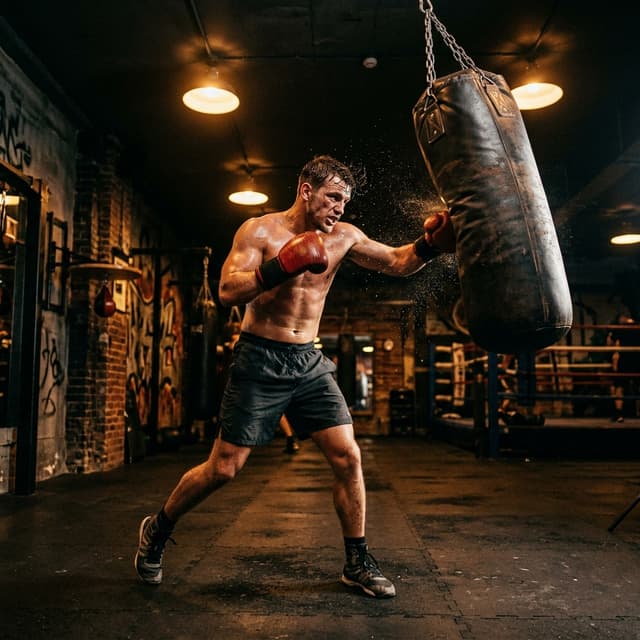
The heavy bag is a 70-100 pound bag that hangs from a ceiling mount or stand. It absorbs impact without moving dramatically, which means it takes full-power shots and lets you feel the feedback of every punch landing. Standard heavy bags are filled with synthetic or natural fiber and weigh between 70 and 150 pounds — heavier bags swing less and are better for power punchers, while lighter bags (around 70 pounds) move more and demand better footwork.
This is where you develop power, practice combinations at full force, and build conditioning. It teaches you what it feels like to hit something solid — the jarring sensation in your knuckles, the impact traveling back through your wrist and forearm. Over time, this builds the knuckle density and wrist toughness needed for hard punching. Mike Tyson's legendary heavy bag sessions showed what full commitment looks like — every punch thrown with intent to destroy, the bag folding around his hooks.
Biomechanically, the heavy bag is the only training tool that lets you practice full kinetic chain power transfer against resistance. When you throw a cross on the heavy bag, you feel whether your rear foot is planted, whether your hips are rotating fully, and whether your fist is aligned with your forearm at impact. A misaligned fist on the heavy bag will cause wrist pain immediately — that instant feedback teaches proper alignment faster than any amount of shadow boxing.
The heavy bag also builds sport-specific conditioning. Hitting a solid object is significantly more fatiguing than hitting air. Three rounds of shadow boxing might leave you slightly winded. Three rounds of heavy bag work at fight pace will have your shoulders burning and your heart rate in the 160-170 range. This is because every punch involves an eccentric braking force on impact — your muscles must absorb the shock of hitting something, which recruits additional motor units and burns more energy.
Every boxing gym has one. For good reason. It is the single most versatile piece of boxing equipment after your own body.
The Double-End Bag: Timing and Accuracy
The double-end bag is a small, round bag — typically 6 to 9 inches in diameter — attached by elastic cords to the floor and ceiling. When you hit it, it snaps back unpredictably, bouncing in multiple directions depending on the angle of your punch, the tension of the cords, and how centered your shot was. This unpredictability is the entire point.
This bag develops timing, accuracy, hand speed, and defensive reflexes because after every punch, the bag bounces back toward your face. You must slip, block, or move your head to avoid it, then time your next punch as the bag swings through its arc. Vasyl Lomachenko's double-end bag work is almost hypnotic — he throws two or three punch combinations then immediately slips the bag's rebound, re-times it, and fires again. It is the closest thing to a sparring partner that is not a human.
The cord tension matters enormously. Tight cords make the bag snap back fast with a short range of motion — this emphasizes reaction speed and rapid-fire combinations. Loose cords allow the bag to swing in wider arcs, demanding better timing but giving you more time to read its movement. Start with moderate tension and adjust as your skill improves.
Biomechanically, the double-end bag teaches accuracy under movement — the skill of landing your fist precisely on a moving target. On a heavy bag, you can throw anywhere and make contact. On the double-end bag, an off-center punch sends the bag sideways and you miss your follow-up shot entirely. This trains the neuromuscular precision that separates a fighter who lands 30% of punches from one who lands 50%.
The double-end bag is where you learn to hit a target that does not stay still — which is what every real opponent does.
What Each Bag Teaches
The training benefits from each bag are distinct — and complementary. Think of the heavy bag as your strength coach and the double-end bag as your timing coach. You need both, and the skills from one transfer directly to the other.
A common drill used by trainers like Abel Sanchez (who trained Gennady Golovkin) is to alternate rounds: one round on the heavy bag focusing on power combinations, then one round on the double-end bag focusing on speed and accuracy. This alternation trains your nervous system to switch between power output and precision — exactly what happens in a fight when you move from throwing power shots at range to quick counters at close distance.
Heavy bag: Power generation through full kinetic chain punching, combination flow and rhythm, fight-specific conditioning, wrist and knuckle toughening from impact, body shot practice at realistic heights, and building confidence in your punching power.
Double-end bag: Timing punches against a moving target, accuracy under pressure, hand speed development, defensive reflexes (slipping the rebound), rhythm and counter-timing, keeping your hands up between punches (because the bag punishes a dropped guard by bouncing into your face), and learning to read movement patterns.
Which to Get First
If you are setting up a home gym and can only get one, get the heavy bag. It costs $80-200, requires a ceiling mount ($20-40) or a free-standing stand ($100-150), and lasts for years with minimal maintenance.
It is more versatile — you can work power, technique, conditioning, body shots, uppercuts, and even defensive footwork all on one piece of equipment. You can throw at 30% power for technical work or 100% for conditioning. No other training tool covers that range.
The double-end bag is a specialist tool that works best once you have basic technique down — specifically, once your jab travels in a straight line consistently and you can throw a 1-2 without losing your balance. For most beginners, that takes 4-8 weeks of regular training. Installing a double-end bag at home requires two anchor points (floor and ceiling), which can be tricky in some spaces, and good double-end bags cost $30-60 plus mounting hardware.
But if your gym has both, use both. A sample session: three rounds heavy bag for power work, two rounds double-end bag for timing and accuracy, then one final round back on the heavy bag for an all-out championship round. This six-round structure covers every skill domain and takes about 25 minutes — one of the most efficient boxing workouts possible.
Common mistake when using both bags: treating the double-end bag like a heavy bag and swinging for power. The double-end bag rewards precision and speed, not force. If you are trying to blast it, you are using the wrong tool for that job. Save the power for the heavy bag.
Other Bags Worth Knowing
The speed bag develops rhythm, shoulder endurance, and timing. It teaches the rebound timing pattern that transfers to reading an opponent's movements. Floyd Mayweather Jr. was famous for his speed bag work, using it to build the shoulder stamina that let him keep his Philly Shell guard active for 12 rounds. However, it is less critical for beginners because the technique takes time to learn and the skills it builds are secondary to fundamentals.
The uppercut bag (teardrop or angled shape) hangs at an angle and lets you practice uppercuts and hooks at realistic trajectories. The angled surface gives proper resistance for upward punches that a standard heavy bag cannot replicate. If you struggle with uppercut technique, this bag is worth the investment.
The maize bag (a small, heavy bag on a rope or swivel) develops head movement and accuracy. You push it, it swings back, and you slip it while throwing counters. It mimics an incoming straight punch better than any other tool. Roberto Duran trained extensively on the maize bag to sharpen the head movement that made him nearly impossible to hit cleanly.
The wrecking ball bag (a large, round heavy bag) is excellent for uppercuts and close-range hooks. It simulates infighting range and is used by pressure fighters who spend a lot of time on the inside.
Build your foundation on the heavy bag and double-end bag first. Add the others as your training evolves and you identify specific skill gaps in your game.
See these techniques broken down by featured creator Coach Josh.
Learn how to use every piece of boxing equipment effectively
The Boxing Blueprint is a 4-part video course covering fundamentals, conditioning, footwork, and fight strategy.
View The Boxing BlueprintReady to Practice?
Put what you learned into action with a guided shadowboxing session or timed heavy bag workout.